📑 Table of Contents
- Heart Surgery Cost in India: A Procedure-by-Procedure Breakdown for International Patients
- Quick Reference: Heart Surgery Costs in India by Procedure
- What Is Typically Included in an Indian Hospital’s Cardiac Surgery Package
- 9 Factors That Determine Your Final Heart Surgery Cost in India
- Hospital Tiers in India: What You Get at Each Level
- Total Trip Cost: Beyond the Surgery Bill
- CABG vs Valve Surgery vs Angioplasty: Key Cost Differences Explained
- India vs Other Medical Tourism Destinations: Cost Comparison
- How to Get an Accurate Cost Estimate for Your Specific Case
- Honest Limitations: When Lower Cost Should Not Be the Primary Driver
Heart Surgery Cost in India: A Procedure-by-Procedure Breakdown for International Patients
Heart surgery is among the most significant medical decisions a person will ever make. When you add the question of where to have it done — and what it will cost — the complexity multiplies quickly. Cost information available online for heart surgery in India is often incomplete, misleadingly low, or presented without the context needed to evaluate it meaningfully.
This guide gives you a realistic, procedure-specific breakdown of what heart surgery costs in India, what those figures typically include, what drives the final number up or down, and how to get an accurate estimate for your specific case rather than a ballpark figure that may bear little resemblance to your actual bill.
India has become one of the world’s foremost destinations for cardiac surgery for verifiable reasons: surgeon volume and experience, internationally accredited hospitals, technology that matches Western standards, and costs that are substantially lower than what patients face in the US, UK, Gulf countries, or Australia. But the cost picture is more nuanced than most sources present, and understanding it properly is the foundation of any good decision.
Quick Reference: Heart Surgery Costs in India by Procedure
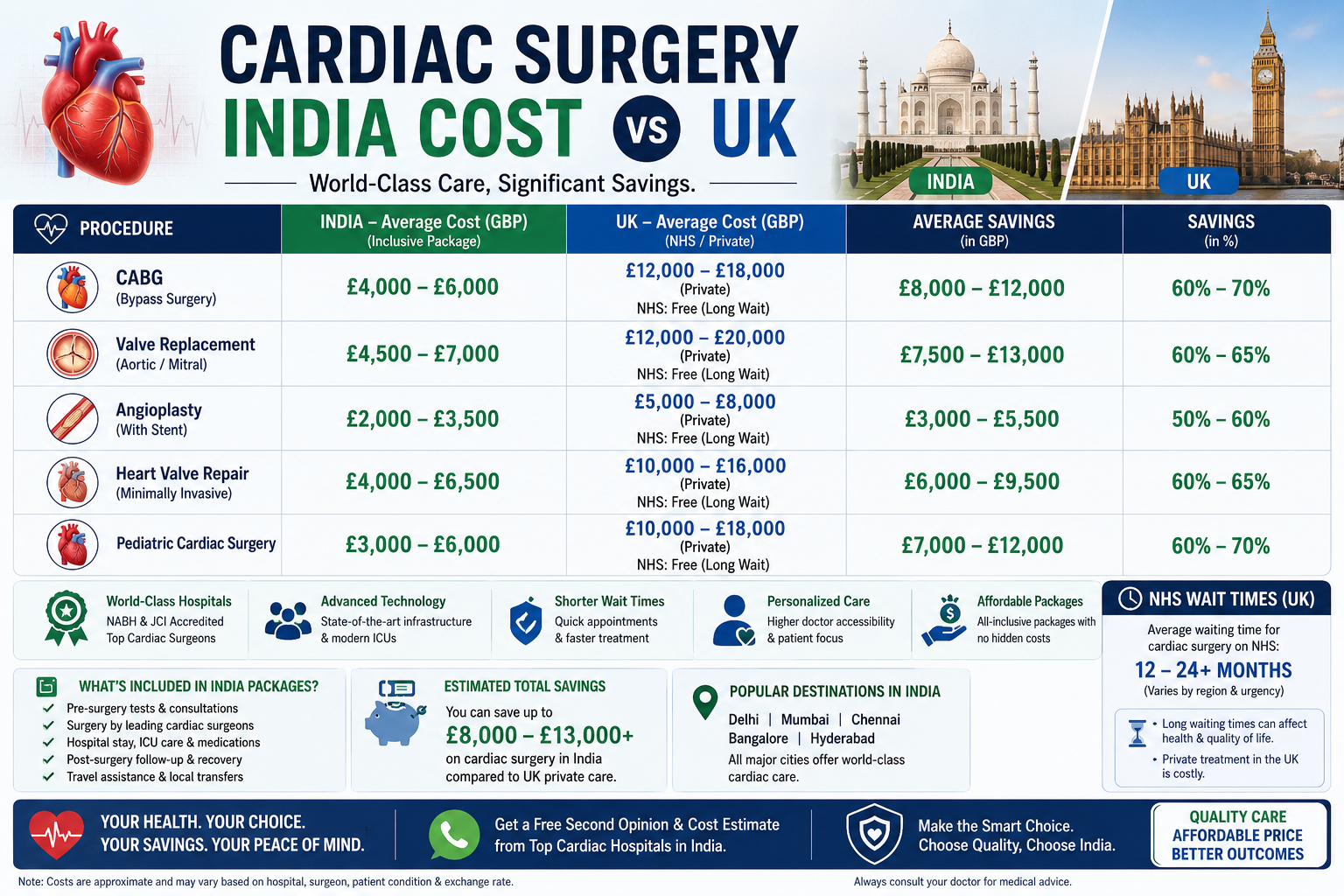
The table below gives indicative cost ranges for major cardiac procedures at accredited hospitals in India. These are not minimum quotes or best-case figures — they reflect the realistic range you should use for initial planning.
All figures are in US dollars (USD) and cover the core procedure. What is and is not included is discussed in detail in the section that follows.
|
Procedure |
India (USD) |
USA (USD) |
UK (USD) |
Saving vs USA |
|
Coronary Artery Bypass Graft (CABG) — Single Vessel |
$5,000–$7,500 |
$70,000–$120,000 |
$25,000–$45,000 |
~90% |
|
Coronary Artery Bypass Graft (CABG) — Double / Triple Vessel |
$6,500–$10,000 |
$80,000–$130,000 |
$30,000–$50,000 |
~92% |
|
Heart Valve Replacement (Mechanical) |
$6,000–$9,500 |
$80,000–$150,000 |
$28,000–$55,000 |
~93% |
|
Heart Valve Replacement (Biological / Tissue) |
$7,500–$12,000 |
$90,000–$160,000 |
$32,000–$60,000 |
~92% |
|
Heart Valve Repair |
$5,500–$9,000 |
$75,000–$140,000 |
$26,000–$50,000 |
~93% |
|
TAVI / TAVR (Transcatheter Aortic Valve Implantation) |
$14,000–$22,000 |
$75,000–$120,000 |
$35,000–$60,000 |
~82% |
|
Angioplasty + Stent (Single Vessel) |
$3,000–$5,500 |
$30,000–$55,000 |
$15,000–$28,000 |
~90% |
|
Angioplasty + Stent (Multiple Vessels) |
$5,000–$9,000 |
$40,000–$80,000 |
$20,000–$40,000 |
~89% |
|
Pacemaker Implantation (Single Chamber) |
$3,500–$6,000 |
$25,000–$50,000 |
$12,000–$22,000 |
~88% |
|
Pacemaker Implantation (Dual / Biventricular) |
$7,000–$13,000 |
$40,000–$70,000 |
$18,000–$35,000 |
~84% |
|
ASD / VSD Repair (Atrial / Ventricular Septal Defect) |
$4,500–$8,000 |
$60,000–$100,000 |
$22,000–$45,000 |
~92% |
|
Congenital Heart Disease Surgery (Complex) |
$7,000–$15,000 |
$80,000–$200,000 |
$35,000–$80,000 |
~93% |
|
Heart Transplant |
$35,000–$60,000 |
$1,000,000+ |
$200,000+ |
~96% |
|
Coronary Angiography (Diagnostic) |
$700–$1,200 |
$5,000–$12,000 |
$3,000–$7,000 |
~88% |
Important: These are planning ranges only. Your actual cost will depend on your specific condition, hospital choice, surgeon, implant type, and length of stay. The section on cost factors below explains each variable in detail.
What Is Typically Included in an Indian Hospital’s Cardiac Surgery Package
One of the most common sources of confusion for international patients is the gap between what a quoted package covers and what the final bill contains. Indian hospitals quote packages differently, and it is critical to verify inclusions before treating any figure as your expected cost.
What Is Generally Included
- Surgeon’s fee and anaesthesiologist’s fee
- Operation theatre charges
- ICU stay (typically 2–5 days for major cardiac surgery)
- Standard hospital room for the recovery period
- Standard nursing care
- Routine post-operative medications for the inpatient period
- Routine post-operative investigations (ECG, echo, blood panels)
- Standard meals during the hospital stay
- Discharge summary and medical documentation
What Is Often Not Included and Must Be Verified
- Cost of the implant itself — valve type (mechanical vs biological vs imported brand), stent type, pacemaker device, or LVAD. This can vary by $3,000–$15,000 depending on the device chosen
- Pre-operative investigations: coronary angiography, echocardiogram, CT angiography, blood tests, and lung function tests if not already done
- Specialist consultations prior to the procedure (cardiologist, pulmonologist, endocrinologist for diabetic patients)
- Companion / attendant accommodation within the hospital
- Medications prescribed at discharge (typically 3–6 months of post-cardiac surgery medication)
- Cardiac rehabilitation sessions, if recommended
- Blood and blood products, if required during surgery
- Management of complications that require additional procedures or extended ICU stay
- International patient coordinator fees, if charged separately by the hospital
|
Always Request an Itemised Estimate Before comparing costs between hospitals, ask each one for a written, itemised cost breakdown — not just a package total. The difference between a ‘package’ that excludes the implant and one that includes it can easily be $8,000–$12,000. An honest cost comparison is only possible with itemised figures. |
9 Factors That Determine Your Final Heart Surgery Cost in India
Two patients with the same diagnosis can face significantly different final costs. The variables below are the primary drivers of that difference:
|
1 |
The Specific Procedure and Its Complexity A single-vessel CABG and a triple-vessel CABG carry different costs, as does a routine valve replacement versus one complicated by prior surgery, heavily calcified tissue, or a combined procedure (valve replacement + CABG simultaneously). Your cardiologist’s assessment of complexity is the most significant single driver of cost. |
|
2 |
Implant and Device Choice For valve replacements, the choice between a mechanical valve, a biological (tissue) valve, and the specific brand matters considerably. A domestic Indian mechanical valve costs far less than an imported biological valve from a top European manufacturer. Similarly, for angioplasty, drug-eluting stent brand and coating technology affect cost. For pacemakers, the device tier (single, dual, biventricular, ICD) creates large cost differences. |
|
3 |
Hospital Tier and Accreditation Level India’s top-tier cardiac hospitals in cities like Delhi, Mumbai, Chennai, Hyderabad, and Bangalore — including those holding both JCI and NABH accreditation — typically charge more than tier-2 city hospitals or those with only domestic accreditation. The premium reflects infrastructure quality, ICU standards, international patient services, and, in most cases, higher surgeon experience volumes. |
|
4 |
Surgeon’s Experience and Seniority Senior cardiac surgeons with high procedure volumes and international training typically command higher fees. For complex procedures, the cost difference between a junior and a senior surgeon is usually $1,000–$3,000 — a premium that most patients consider well justified. |
|
5 |
Room Category Indian hospitals offer multiple room tiers: general ward, shared room, private room, and suite. The difference in room charges across these categories can be $100–$400 per day, which over a 7–10 day stay adds up meaningfully. Some international patient packages default to private rooms; others let you choose. |
|
6 |
Length of ICU and Hospital Stay Routine cardiac surgery stays in India run 7–14 days in total (2–5 in ICU, rest in a standard ward). Complications, co-morbidities like diabetes or renal impairment, or a need for extended cardiac monitoring will extend the stay and the cost accordingly. ICU days in India typically run $200–$400 per day at top hospitals. |
|
7 |
Pre-Operative Investigations If you arrive without a complete cardiac workup, you will need a coronary angiography ($700–$1,200), echocardiogram ($100–$250), CT coronary angiography ($500–$900), and a full pre-op blood panel ($150–$300) before surgery can be planned. Patients who bring comprehensive recent reports from home can avoid some of these costs. |
|
8 |
City and Geography Cardiac surgery in Delhi, Mumbai, and Chennai is generally priced slightly higher than the same procedure in Hyderabad, Ahmedabad, Kochi, or Chandigarh — reflecting real estate and operating cost differences. The quality at leading hospitals in tier-2 cities is, in many cases, equivalent. |
|
9 |
Number of Accompanying Persons and Duration of Stay Most international patients travel with at least one companion. Accommodation for a companion within the hospital (in-room attendant cot or separate room) and meals add $30–$80 per day. A companion who stays in a nearby hotel for 10–14 days adds another $700–$1,500 to total trip cost depending on the city and hotel tier. |
Hospital Tiers in India: What You Get at Each Level
Not every hospital in India offers the same standards, and cost is a partial but imperfect proxy for quality. Understanding what hospital tiers exist and what they actually deliver helps you make a smarter decision than simply choosing the cheapest quote.
|
Tier |
What It Typically Offers |
Considerations for International Patients |
|
Tier 1 Premium JCI + NABH (Apollo, Fortis, Max, Medanta, AIIMS-level specialists) |
Highest surgical volumes; robotic and minimally invasive cardiac options; dedicated international patient departments; multilingual coordinators; internationally trained senior surgeons |
Best choice for complex cases, re-do surgeries, congenital heart disease, TAVI/TAVR, and heart transplants. Marginally higher cost, significantly more support infrastructure. |
|
Tier 2 NABH Accredited Regional Leaders |
Strong cardiac surgery departments with experienced surgeons; NABH accreditation; good ICU standards; limited or basic international patient services |
Good option for straightforward CABG, valve replacement, or angioplasty if cost is a significant factor. Less support for international logistics; may require a facilitator. |
|
Tier 3 Unaccredited or State Hospitals |
Variable quality; lower cost; may have strong individual surgeons without institutional quality systems |
Not recommended for international patients. The absence of independent accreditation makes quality verification difficult. |
Total Trip Cost: Beyond the Surgery Bill
Your surgery bill is the largest cost, but it is not the only one. International patients planning cardiac surgery in India should budget for the following additional components:
|
Cost Component |
Estimated Range (USD) |
Notes |
|
Return flights (patient + 1 companion) |
$600–$3,000 |
Varies significantly by origin country. Business class may be needed post-surgery. |
|
Medical visa (India e-VISA or sticker visa) |
$25–$100 |
India medical visa is straightforward; valid for 1 year with multiple entries |
|
Pre-operative stay (hotel, 3–5 days before surgery) |
$150–$600 |
Hospital admission typically 1 day before surgery; pre-op investigations may require additional days |
|
Post-operative stay after discharge (hotel, 7–10 days) |
$350–$1,200 |
Hospitals generally require patients to remain locally available for 7–14 days post-discharge before flying |
|
Companion accommodation and meals |
$500–$1,500 |
Dependent on hotel tier and duration of stay |
|
Local transport (airport, hospital, hotel) |
$100–$300 |
Hospital international patient departments often arrange airport pick-up and hospital transfers |
|
Discharge medications (typically 3 months) |
$80–$250 |
Post-cardiac surgery medications in India are a fraction of Western pharmacy prices |
|
Travel / health insurance |
$150–$500 |
Strongly recommended; some insurers exclude pre-existing conditions for international medical travel policies |
For a typical CABG or valve replacement trip from the Middle East, Africa, or South Asia, total additional costs outside the surgery bill generally range from $2,000 to $6,000 depending on origin country and duration of stay. From Europe, the US, or Australia, flights add to this meaningfully.
CABG vs Valve Surgery vs Angioplasty: Key Cost Differences Explained
Patients researching cardiac surgery in India often have one of three primary procedures in mind. Understanding why their costs differ helps you interpret quotes more accurately.
Coronary Artery Bypass Graft (CABG)
CABG involves using a graft vessel (typically the internal mammary artery or saphenous vein from the leg) to bypass blocked coronary arteries. It is an open-heart procedure requiring cardiopulmonary bypass in most cases. Cost drivers specific to CABG include the number of vessels bypassed, whether the procedure is done on a beating heart (off-pump CABG, which reduces complications in some patients), and whether any additional procedures such as valve repair are performed simultaneously. Indian surgeons perform some of the highest CABG volumes in the world, and outcomes at leading centres are comparable to the best international data.
Heart Valve Replacement and Repair
Valve surgery costs are heavily influenced by implant choice. A domestic mechanical valve may cost $400–$600, while a premium imported tissue valve (such as those from Edwards Lifesciences or Medtronic) can cost $5,000–$9,000 for the implant alone — before surgeon and hospital fees. This single variable can shift the total procedure cost by $5,000–$8,000. Valve repair, where the native valve is reconstructed rather than replaced, typically costs less than replacement and offers certain clinical advantages; not all patients are candidates. Ask specifically whether your surgeon recommends repair or replacement and why.
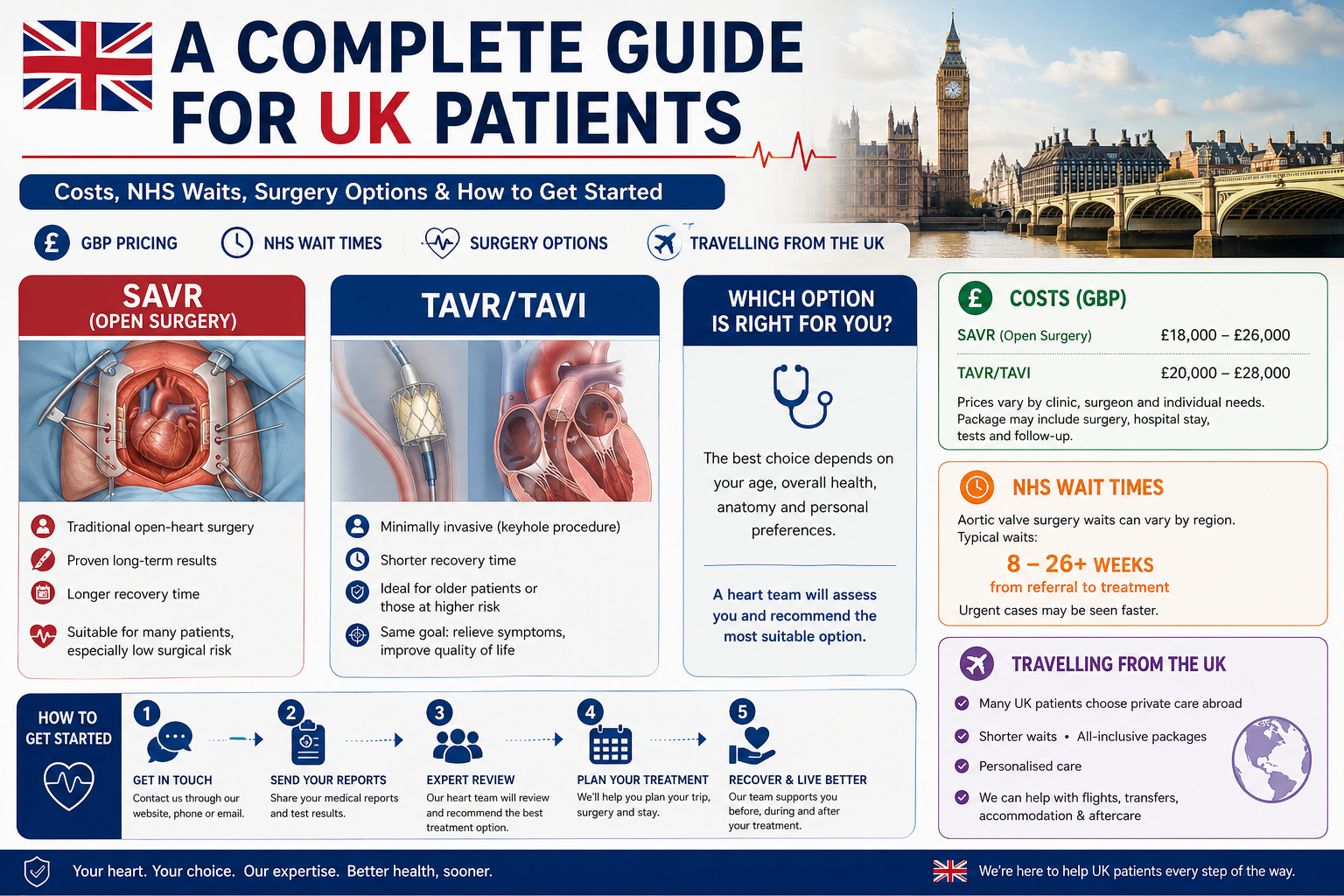
TAVI / TAVR
Transcatheter aortic valve implantation is a minimally invasive alternative to open valve surgery, typically recommended for patients with high surgical risk. In India, TAVI is performed at a smaller number of highly specialised centres. The procedure costs more than surgical valve replacement because the transcatheter device itself is expensive ($10,000–$18,000 for the valve alone) and requires specialised hybrid cathlab infrastructure. India’s TAVI costs are still 75–85% below US figures.
Coronary Angioplasty and Stenting
Angioplasty is a catheter-based, non-surgical procedure and generally the lowest-cost cardiac intervention. The main cost variable is stent type — bare metal stents are cheapest, drug-eluting stents more expensive, and bioresorbable scaffold stents the most expensive. The number of vessels stented and whether the procedure is done electively or as an urgent intervention also affects cost. Most international patients coming to India for angioplasty are either seeking elective treatment at lower cost than home, or combining it with a diagnostic workup.
India vs Other Medical Tourism Destinations: Cost Comparison
India is not the only country international patients consider for cardiac surgery. The comparison below covers the most common alternatives:
|
Country |
CABG (USD) |
Valve Replacement (USD) |
Angioplasty (USD) |
Key Considerations |
|
India |
$6,500–$10,000 |
$6,000–$12,000 |
$3,000–$9,000 |
Highest surgical volumes; JCI + NABH accredited hospitals; English widely spoken; strong international patient infrastructure |
|
Thailand |
$15,000–$22,000 |
$18,000–$28,000 |
$8,000–$14,000 |
Strong hospital quality; high tourism infrastructure; lower cardiac surgery volumes than India; higher cost |
|
Turkey |
$10,000–$18,000 |
$12,000–$20,000 |
$6,000–$12,000 |
Good quality at leading hospitals; more accessible for European patients; mid-range cost |
|
Malaysia |
$12,000–$18,000 |
$14,000–$22,000 |
$7,000–$12,000 |
High quality private hospitals; smaller scale than India; better option for Southeast Asian patients |
|
Singapore |
$25,000–$45,000 |
$30,000–$55,000 |
$15,000–$25,000 |
World-class standards; significantly higher cost; preferred when proximity to SE Asia matters and budget is not a constraint |
India’s primary advantages over other medical tourism destinations for cardiac surgery are surgical volume and experience at the specialist level, cost, and the depth of JCI/NABH-accredited infrastructure. For patients from Africa, the Middle East, South Asia, and Central Asia, India also offers geographic and logistical advantages.
How to Get an Accurate Cost Estimate for Your Specific Case
The most important thing to understand about heart surgery costs in India is that a general range, however carefully researched, cannot substitute for a case-specific estimate. Two patients presenting with ‘valve replacement’ can face final bills that differ by $8,000 or more depending on individual clinical variables.
Here is how to get a reliable cost estimate:
|
1 |
Gather Your Current Medical Records Collect your most recent reports: echocardiogram, coronary angiography (if done), CT angiography, ECG, blood reports, and any surgical history. The more complete your file, the more accurate the estimate. |
|
2 |
Share Reports for a Specialist Review Before Asking for Cost A cost estimate without a clinical review is meaningless. The surgeon reviewing your case needs to understand what procedure is actually required before any figure can be meaningful. Estimates given without reviewing your records should be treated with scepticism. |
|
3 |
Ask for Itemised Breakdown, Not Package Total Request a line-item breakdown: surgeon fee, anaesthesia, OT, ICU per day, room per day, implant (with specific device name and manufacturer), standard investigations, and medications. This is the only way to compare across hospitals honestly. |
|
4 |
Clarify What Happens If Complexity Increases Ask specifically: what happens to cost if the procedure takes longer than expected, if additional bypass vessels are required, if the ICU stay extends beyond the estimated days, or if a complication requires a return to the OT. Knowing how costs escalate is as important as knowing the base figure. |
|
5 |
Get a Video Consultation with the Treating Surgeon Before committing to travel, speak directly with the surgeon who will perform the procedure. This serves two purposes: you can evaluate the surgeon directly, and the surgeon’s first-hand review of your case may revise the estimate up or down compared to what a coordinator initially provided. |
|
6 |
Verify Hospital Accreditation Independently Check the hospital’s NABH status at the NABH public portal and JCI status at the JCI official website. Do not rely solely on the hospital’s own claims. Accreditation can lapse or be under renewal. |
Honest Limitations: When Lower Cost Should Not Be the Primary Driver
This guide has made the case for India’s cost advantage honestly and with evidence. It is equally important to be clear about when cost should not be the primary criterion:
- For a heart transplant, matching, timing, and surgical team experience matter far more than cost. India performs heart transplants, but the waiting list and donor availability depend on local factors that require careful pre-planning.
- For re-do cardiac surgeries — procedures on patients who have had previous open heart surgery — complexity and risk are significantly elevated. The choice of hospital and surgeon for a re-do should prioritise volume and expertise in complex re-operative cases specifically.
- For paediatric congenital heart disease surgery, the specialist team’s paediatric cardiac surgery volume is the critical variable. A handful of Indian centres perform these procedures at world-class volumes; the broader hospital landscape does not.
- If your cardiac condition is unstable or you require urgent intervention, international travel is not appropriate. All guidance in this document applies to planned, elective cardiac surgery only.
- Patients with multiple serious co-morbidities — severe renal disease, uncontrolled diabetes, or advanced lung disease — require careful pre-operative evaluation and may face higher risk and higher cost than the ranges in this guide suggest.
|
Get a Case-Specific Heart Surgery Cost Estimate The cost ranges in this guide give you a realistic planning baseline. Your actual cost depends on your specific diagnosis, the procedure your surgeon recommends, your implant choices, and the hospital you choose. Share your cardiac reports with our team. A specialist will review your case and provide a written treatment plan with a detailed, itemised cost estimate — so your comparison is based on real numbers for your specific situation, not general ranges. Free. Confidential. Reports reviewed within 24–48 hours. No obligation. | www.racurehealthcare.com |
🫀 Need Expert Cardiac Care?
Our experienced cardiac surgeons can help you understand your options and plan the best treatment.