📑 Table of Contents
- A Complete Guide for UK Patients — Costs, NHS Waits, Surgery Options & How to Get Started
- Heart Valve Replacement in India — Your Two Main Options
- Mechanical vs. Biological Valve — What Will You Actually Receive?
- The UK Situation: NHS Waits and Private Costs
- What Will You Actually Spend? An Honest All-In Estimate
- Getting There: Flying From the UK to India
- The Process — From Your GP Referral to Valve Surgery in India
- Will the Quality of Care Match What I'd Receive in the UK?
- Aftercare — Working With Your NHS Cardiologist After You Return
- UK Patient Questions — Answered Directly
- Get a Written Valve Surgery Quote for Your Case
A Complete Guide for UK Patients — Costs, NHS Waits, Surgery Options & How to Get Started
If you've been diagnosed with a faulty heart valve in the UK, you're facing one of two difficult realities. Under the NHS, you may be looking at a significant wait for elective valve surgery — particularly if your case has been classified as non-urgent. Through private healthcare in the UK, the cost of valve replacement is among the highest of any cardiac procedure.
India offers a third option that an increasing number of UK patients are choosing: world-class valve surgery at a fraction of private UK cost, performed by surgeons with training and experience that matches the best cardiac centres in Britain — often with appointments available within weeks, not months.
This guide is written specifically for UK patients. It covers the valve replacement options available in India, how costs compare to both the NHS and UK private care, what to expect from the process, and how to get started.
|
Get a Free Valve Surgery Quote — Replied to Within 24–48 Hours Send your echocardiogram and referral letter. No obligation. Fully confidential. |
Heart Valve Replacement in India — Your Two Main Options
The first thing to understand is that 'heart valve replacement' covers two significantly different procedures, with very different costs, recovery times, and suitability criteria. Your cardiologist's recommendation will determine which applies to you — but knowing the difference helps you plan properly.
|
|
SAVR — Open-Heart Surgery |
TAVR / TAVI — Minimally Invasive |
|
What it is |
Surgical valve replacement via a chest incision, under general anaesthesia and on heart-lung bypass |
Valve delivered via a catheter (usually through the femoral artery in the leg), no chest opening |
|
Suitable for |
Younger patients, lower surgical risk, complex valve anatomy requiring precise surgical repair |
Older patients, higher surgical risk, those who have had previous cardiac surgery |
|
India cost (GBP) |
£3,900 – £7,000 (all-in, hospital stay included) |
£15,500 – £35,000 (valve device is the major cost driver) |
|
Hospital stay |
7–10 days |
2–4 days |
|
Recovery time |
8–12 weeks full recovery |
4–6 weeks full recovery |
|
Min. stay in India |
3–4 weeks before flying home |
10–14 days before flying home |
Mechanical vs. Biological Valve — What Will You Actually Receive?
Regardless of whether you have SAVR or TAVR, the replacement valve itself is a key decision. There are two types, and the choice has long-term implications:
|
Valve Type |
Mechanical Valve |
Biological (Tissue) Valve |
|
Material |
Carbon and titanium — engineered to last decades |
Treated animal tissue (porcine or bovine), or human tissue |
|
Durability |
Potentially lifelong — rarely needs replacement |
Typically lasts 10–20 years; may require replacement later |
|
Blood Thinners |
Required for life (warfarin) — permanent daily medication |
Usually only needed short-term post-surgery (3–6 months) |
|
Best for |
Younger patients (under 60–65) who can manage lifelong anticoagulation |
Older patients or those who cannot safely take long-term blood thinners |
|
TAVR compatibility |
Mechanical valves are not used in TAVR — only in SAVR |
All TAVR procedures use biological tissue valves |
|
Discuss This With Your Surgeon Before You Travel The valve type decision should ideally be confirmed during your pre-travel video consultation with your Indian cardiac surgeon — not after you arrive. Your age, lifestyle, INR monitoring capability at home, and specific valve anatomy all influence which valve is most appropriate for you. |
The UK Situation: NHS Waits and Private Costs
NHS Wait Times for Valve Surgery
NHS wait times for elective cardiac valve surgery vary significantly by NHS trust and the urgency classification of your case. Patients classified as urgent or emergency are prioritised, but those classified as routine or soon can face considerable waits — sometimes extending beyond six months, and in some regions beyond a year. For a condition like aortic valve stenosis, which tends to progress, a lengthy wait is not simply an inconvenience — it can have clinical consequences.
Private UK Cost for Valve Replacement
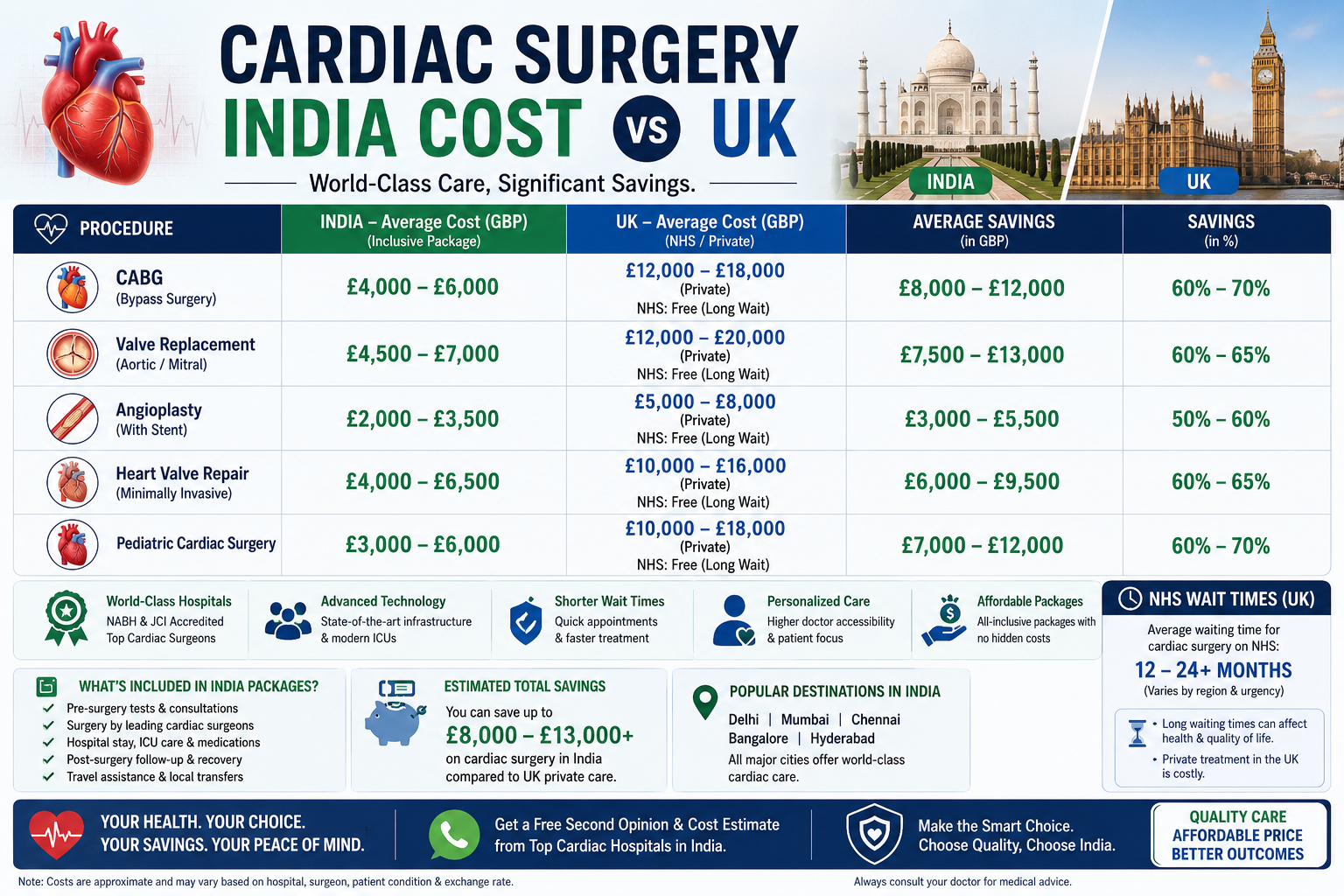
If you choose private healthcare in the UK to avoid the NHS wait, heart valve replacement is among the most expensive private cardiac procedures available:
|
Procedure |
Private UK Cost (GBP) |
India Cost (GBP) |
|
SAVR — Surgical Valve Replacement |
£20,000 – £35,000 |
£3,900 – £7,000 |
|
TAVR / TAVI |
£30,000 – £60,000+ |
£15,500 – £35,000 |
|
Mitral Valve Repair (SAVR) |
£22,000 – £38,000 |
£4,500 – £8,000 |
Even accounting for flights and 3–4 weeks of accommodation in India, the total cost of valve surgery in India is typically 70–80% lower than UK private rates — and it avoids the NHS waiting period entirely.
What Will You Actually Spend? An Honest All-In Estimate
For a UK patient travelling to India for surgical valve replacement (SAVR), here is a realistic all-in cost breakdown:
|
Expense |
Estimated Cost (GBP) |
|
SAVR surgery including hospital stay (7–10 days) |
£3,900 – £7,000 |
|
Return flights (UK to India — varies by departure city) |
£400 – £750 |
|
Post-discharge accommodation (2–3 weeks, near hospital) |
£250 – £600 |
|
Attendant accommodation (if family member travels with you) |
£200 – £500 |
|
Local transport, outpatient visits, incidentals |
£80 – £180 |
|
Medical Visa (patient + attendant if applicable) |
£50 – £90 |
|
Estimated All-In Total |
£4,880 – £9,120 |
At the upper end, you're still spending less than a quarter of what SAVR costs privately in the UK — and receiving the same procedure at a JCI-accredited hospital with a surgeon who may have performed many more valve replacements than the average UK private cardiac surgeon.
Getting There: Flying From the UK to India
UK patients have several practical flight options depending on which Indian city their chosen hospital is in:
|
Destination (India) |
Key UK Route Information |
|
Delhi (IGI Airport) |
Direct flights from London Heathrow, Birmingham, and Manchester. Approximately 8.5–9 hours. Medanta, FMRI, Max Saket, and BLK-Max are all within 30–45 minutes of the airport. |
|
Mumbai (CSMIA Airport) |
Direct flights from London Heathrow. Approximately 9–10 hours. Kokilaben, Lilavati, and Tata Memorial are well-connected from the airport. |
|
Chennai (MAA Airport) |
No direct flights from the UK — typically 1 stop via Gulf hubs (Dubai, Doha, Abu Dhabi). Total journey approximately 11–13 hours. Apollo Chennai is the primary valve surgery destination. |
|
Bengaluru (KIA Airport) |
No regular direct flights from the UK — typically 1 stop via Gulf hubs. Medanta Narayana and Manipal Hospitals are good valve surgery options here. |
|
Book Flexible Fares Until You Have Surgical Clearance Do not book non-changeable flights until your surgery date is confirmed. Pre-operative evaluation in India may result in minor schedule adjustments. Book fares that can be changed without significant penalty, and avoid booking your return flight until your surgeon has assessed your recovery and confirmed flying clearance. |
The Process — From Your GP Referral to Valve Surgery in India
1. Gather Your Cardiac Reports
You'll need your echocardiogram report (the key document confirming valve disease severity), your GP referral letter or NHS consultant letter, and any relevant blood tests or cardiac imaging. If you have an angiogram or CT, include those too.
2. Send Reports to Our Team
Share your reports with Racure Healthcare and we'll review your case with a cardiac specialist, confirm whether SAVR or TAVR is the recommended approach for your case, and match you with the most appropriate hospital and surgeon in India.
3. Receive a Written Treatment Plan and GBP Cost Estimate
Within 24–48 hours you'll receive a written treatment plan and a clear, itemized cost estimate in GBP — not a verbal range — covering the surgery, valve, hospital stay, and follow-up visits before you fly.
4. Pre-Travel Video Consultation With Your Surgeon
Before booking anything, you'll have a video consultation with your treating cardiac surgeon in India. Bring your questions. Discuss your valve type options, the approach, and what your specific recovery timeline is likely to look like.
5. Medical Visa and Travel Arrangements
We coordinate the hospital invitation letter required for your Indian Medical Visa application, advise on routing and travel dates, and arrange airport pickup and accommodation near your hospital.
6. Surgery, Recovery, and Home
Your dedicated patient coordinator manages logistics throughout your stay. Before discharge, you'll receive a full surgical summary, your medication plan, and a fit-to-fly confirmation for your return journey.
Will the Quality of Care Match What I'd Receive in the UK?
This is the right question to ask, and the honest answer is: at JCI-accredited hospitals, yes — for the specific procedure of valve replacement, the clinical standards are comparable to the best private cardiac centres in the UK.
- JCI accreditation is the same standard used to assess hospitals in the US and is internationally recognised as equivalent to the UK’s CQC standards for private hospitals
- Many senior Indian cardiac surgeons have done fellowships or training at British cardiac centres – the clinical language, familiarity with technique and standards of medical records are directly compatible.
- The same imported valve brands used in UK private hospitals (Edwards Lifesciences and Medtronic for TAVR, St Jude and Medtronic mechanical valves for SAVR) are available and routinely used in India.
- English is used throughout the clinical language – all medical records, surgical notes and discharge summaries are produced in English and are immediately usable by your NHS GP or cardiologist on your return
Aftercare — Working With Your NHS Cardiologist After You Return
One of the most important practical steps for UK patients is ensuring a smooth handover back to NHS care after returning home. Here's how to make this work:
- Request a full discharge package from your Indian hospital—surgical notes, operation record, echocardiogram post-surgery, medication list, and follow-up plan—all in English
- Book an appointment with your GP within the first week of returning home to share these records
- Your GP can refer you back to your NHS cardiologist for post-operative follow-up—this is standard practice for patients who had planned surgery abroad
- Your INR monitoring (if you have a mechanical valve) can be managed through your GP surgery once you're back in the UK
- Your Indian cardiac team remains contactable for clinical questions—your Racure coordinator can facilitate this communication
UK Patient Questions — Answered Directly
Will my NHS treatment be affected if I have surgery in India?
No. Having surgery privately abroad does not affect your NHS entitlements. You can still access NHS cardiac follow-up care, prescriptions, and ongoing cardiology monitoring through your GP and NHS cardiologist on your return. Many UK patients who have had surgery abroad return to NHS care for their follow-up without any issues.
Can I get travel insurance that covers pre-existing cardiac conditions?
This is worth researching carefully before you travel. Standard travel insurance often excludes pre-existing cardiac conditions. Specialist medical travel insurance providers exist in the UK who offer cover for patients with cardiac conditions traveling for treatment — search specifically for 'medical travel insurance pre-existing conditions UK' and compare policies. Racure Healthcare can advise on what documentation insurers typically require.
What if I need my NHS cardiologist to review the Indian treatment plan?
This is entirely reasonable and encouraged. Share the written treatment plan you receive from India with your NHS cardiologist for their opinion before you commit. Most NHS cardiologists are familiar with India's leading cardiac centres and can offer a meaningful second opinion on the proposed approach.
How will I manage my warfarin (or other anticoagulants) after returning to the UK?
Your discharge documentation from India will include your medication protocol including target INR range if you have a mechanical valve. Your GP surgery can manage INR monitoring through their anticoagulant clinic. Some GP practices refer patients to a local INR clinic — ask your surgery about this when you return.
Are there UK-based patient communities of people who have had heart surgery in India?
Yes — there are active communities on Facebook and patient forums where UK patients who have had cardiac surgery in India share their experiences, hospital recommendations, and recovery tips. Searching 'heart surgery India UK patients' on Facebook will find these groups. They can be a valuable source of first-hand information alongside what any facilitator or hospital tells you.
Get a Written Valve Surgery Quote for Your Case
Whether you're on an NHS waiting list, weighing private UK costs, or simply exploring your options, the most useful next step is a real, written quote based on your actual reports — not an average figure from a website.
Share your echocardiogram and any referral letters with our team, and we'll send you a personalised treatment plan and GBP cost estimate within 24 to 48 hours — with a pre-arranged video consultation with your cardiac surgeon to follow.
|
Get Your Free Valve Surgery Quote in GBP Echocardiogram and reports reviewed within 24–48 hours. No obligation. Fully confidential. |
🫀 Need Expert Cardiac Care?
Our experienced cardiac surgeons can help you understand your options and plan the best treatment.