📑 Table of Contents
- Cardiac Surgery Cost: India vs UK A Procedure-by-Procedure Breakdown of What You'll Actually Pay
- Cardiac Surgery Cost Comparison: India vs Private UK
- The NHS Dimension: What 'Free' Actually Costs You
- What Makes Up the Cost — India vs UK, Component by Component
- All-In Cost for a UK Patient Having CABG in India
- Why India's Cardiac Surgery Costs Are Lower — The Real Explanation
- Verifying Quality: What the Accreditation Data Actually Says
- How to Get a Real Quote — Not an Average Figure
- Frequently Asked Questions
Cardiac Surgery Cost: India vs UK A Procedure-by-Procedure Breakdown of What You'll Actually Pay
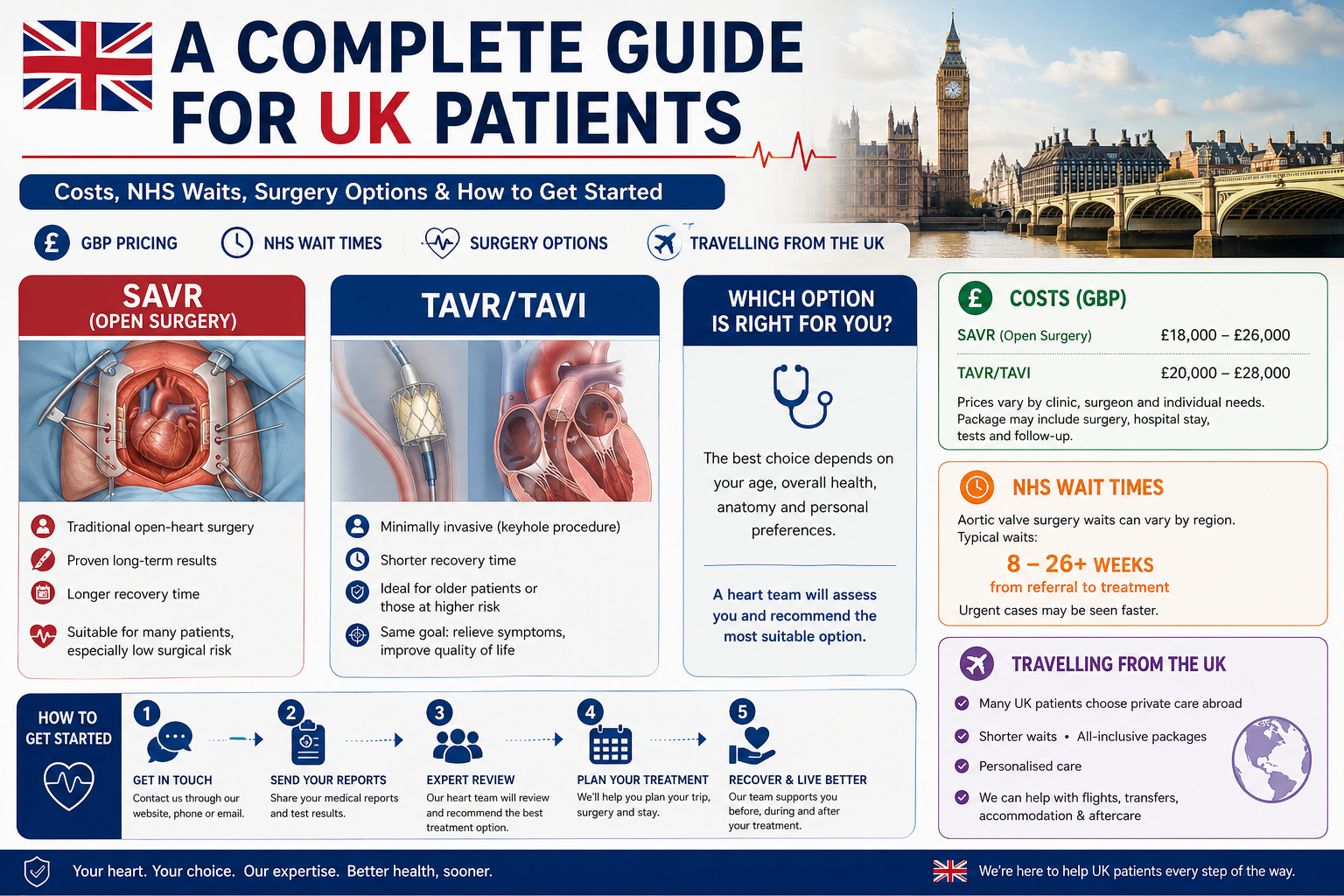
If you need cardiac surgery and you're based in the UK, the financial calculation is straightforward on paper but surprising in practice. NHS treatment is free — but the wait can be clinically significant. Private cardiac surgery in the UK avoids the wait, but the price of open-heart procedures puts it out of reach for most people without comprehensive private insurance.
India sits between these two options — not as a compromise, but as a genuine clinical alternative. This article focuses specifically on cardiac surgery costs, breaking down what you'll pay procedure by procedure, what each cost actually includes, and what drives the price difference so you can evaluate the comparison honestly.
Cardiac Surgery Cost Comparison: India vs Private UK
All figures in GBP. Private UK costs reflect self-pay rates at major UK private cardiac centres. India costs reflect rates at JCI or NABH-accredited hospitals for international patients.
|
Cardiac Procedure |
Private UK Cost (£) |
India Cost (£) |
|
Coronary Artery Bypass (CABG) |
£24,000 – £38,000 |
£3,900 – £7,000 |
|
Aortic Valve Replacement (SAVR) |
£20,000 – £35,000 |
£3,900 – £7,000 |
|
Mitral Valve Replacement (SAVR) |
£22,000 – £38,000 |
£4,500 – £8,000 |
|
Mitral Valve Repair |
£24,000 – £40,000 |
£4,800 – £9,000 |
|
TAVR / TAVI |
£30,000 – £60,000+ |
£15,500 – £35,000 |
|
Angioplasty + Drug-Eluting Stent |
£8,000 – £14,000 |
£2,000 – £4,500 |
|
Off-Pump (Beating Heart) CABG |
£26,000 – £42,000 |
£4,500 – £8,000 |
|
Aortic Aneurysm Repair (Open) |
£25,000 – £45,000 |
£5,500 – £10,000 |
|
Heart Transplant |
NHS only (not typically available privately in UK) |
£27,000 – £43,000 |
|
Pacemaker Implantation (Dual Chamber) |
£7,000 – £12,000 |
£2,500 – £5,000 |
|
ICD Implantation |
£9,000 – £16,000 |
£3,000 – £6,500 |
Figures are indicative ranges based on published self-pay rates and hospital cost data. Your exact quote will depend on procedure complexity, surgeon seniority, room category, and individual case factors.
The NHS Dimension: What 'Free' Actually Costs You
NHS cardiac surgery is not literally free — it is funded through taxation. But the patient-facing cost is zero, which means the relevant question for anyone comparing NHS versus India is not about money: it's about time.
|
Procedure |
NHS Wait (Typical Range) |
India Wait From Decision |
|
CABG (non-urgent) |
12–18 weeks (varies widely by trust) |
1–2 weeks |
|
Valve Replacement (elective) |
18–52 weeks+ |
1–2 weeks |
|
TAVR / TAVI |
Often faster (high-risk patients prioritised) |
1–2 weeks |
|
Angioplasty (elective) |
6–18 weeks |
3–5 days |
|
Pacemaker Implantation |
4–12 weeks |
3–7 days |
|
The Clinical Cost of Waiting Aortic stenosis, heart failure, and coronary artery disease all tend to progress over time. For conditions where symptoms are worsening or the valve/arterial disease is severe, a 6–12 month wait is not just inconvenient — it can mean operating on a more deteriorated patient at higher surgical risk than if the procedure had been done sooner. Your cardiologist's assessment of urgency should drive whether speed of access matters for your specific case. |
What Makes Up the Cost — India vs UK, Component by Component
Understanding why the cost is so different requires looking at what the total bill is actually made up of. These are the main cost components for open cardiac surgery:
|
Cost Component |
India (JCI-Accredited Hospital) |
UK Private Hospital |
|
Surgeon's professional fee |
£400 – £900 |
£3,000 – £6,000+ |
|
Anaesthetist's fee |
£150 – £350 |
£1,000 – £2,500 |
|
Operating theatre / cath lab charges |
£500 – £1,200 |
£3,000 – £6,000 |
|
ICU monitoring (per day) |
£150 – £300 |
£1,200 – £2,500 |
|
Standard ward stay (per day) |
£80 – £200 |
£600 – £1,500 |
|
Prosthetic valve (biological, SAVR) |
£600 – £1,500 |
£2,000 – £4,000 |
|
Transcatheter valve device (TAVR) |
£12,000 – £25,000 |
£20,000 – £35,000+ |
|
Pre-op assessment (echo, bloods, ECG) |
£200 – £500 |
£800 – £2,000 |
|
Post-op medication (during stay) |
Typically included |
Often billed separately |
The cost difference is not concentrated in one area — it runs across every component. UK private hospitals carry substantially higher operating costs: property, staffing wages relative to UK cost of living, regulatory compliance overheads, and insurance-driven billing structures all contribute. India's hospitals use the same medical equipment and many of the same imported consumables — the overhead economics simply operate on a different scale.
All-In Cost for a UK Patient Having CABG in India
Here is a realistic total spend for a UK patient traveling to India for coronary artery bypass surgery, including all associated travel and stay expenses:
|
Expense Item |
Estimated Cost (GBP) |
|
CABG surgery — surgeon, theatre, ICU, 7–10 day hospital stay |
£3,900 – £7,000 |
|
Return flights London to Delhi (economy, flexible fare) |
£450 – £750 |
|
Post-discharge accommodation near hospital (2–3 weeks) |
£250 – £600 |
|
Accompanying attendant accommodation (same period) |
£200 – £500 |
|
Outpatient follow-up visits before flying (transport included) |
£60 – £150 |
|
Medical Visa — patient and one attendant |
£50 – £90 |
|
Incidentals (meals out, local transport, SIM card) |
£80 – £200 |
|
TOTAL ESTIMATED SPEND |
£4,990 – £9,290 |
Even at the top of this all-in range, the total spend is less than half the cost of the least expensive private CABG quote available in the UK — and the procedure, valve, and postoperative care are delivered to identical clinical standards.
Why India's Cardiac Surgery Costs Are Lower — The Real Explanation
Patients reasonably worry that lower cost means lower quality. The honest explanation for the price gap is structural, not clinical:
Surgeon and Staff Salaries Reflect Local Economics
A senior cardiac surgeon in India earns significantly less in absolute terms than a UK private cardiac surgeon — not because their skill is lesser, but because cost of living, housing, and general economic benchmarks are fundamentally different. Many of India's top cardiac surgeons trained in the UK, US, or Australia and returned to India — they bring the same clinical training at a fraction of the UK salary structure.
No Insurance Billing Inflation
In the UK private sector, pricing is heavily shaped by insurer negotiation and billing structures that tend to inflate listed procedure costs. Indian hospitals price cardiac surgery directly to international self-pay patients without this layer of insurance-driven cost inflation.
Higher Procedure Volume = Lower Per-Case Overhead
India's top cardiac centres perform a far higher volume of procedures annually than most UK private cardiac units. Medanta alone performs thousands of cardiac surgeries per year. Higher volume means lower per-case overhead, and critically, it also means more experienced surgical teams — volume and outcome quality are directly correlated in cardiac surgery research.
Imported Consumables Are the Same
Cardiac stents, prosthetic valves, sutures, bypass circuits, and pacemaker devices are imported from the same global manufacturers used in the UK. The difference in consumable costs between India and the UK is far smaller than the overall procedure cost difference — which reinforces that the savings are structural, not a reflection of inferior materials.
Verifying Quality: What the Accreditation Data Actually Says
- JCI-accredited cardiac hospitals in India are assessed against the same international patient safety standard used to evaluate private hospitals in the UK and US — this is independently verifiable through JCI's public database
- Success rates for CABG at India's leading cardiac hospitals are consistently reported in the 95–98% range — comparable to published UK private cardiac centre outcomes
- Many of India's most senior cardiac surgeons are FRCS-qualified (Fellow of the Royal College of Surgeons), hold FRCP membership, or trained at NHS cardiac centres
- Mortality rates for elective CABG at high-volume Indian cardiac centres — Medanta, Fortis Escorts, Narayana Health City — are broadly equivalent to published NHS and private UK outcomes
- Post-operative cardiac care in India follows the same international ERAS (Enhanced Recovery After Surgery) protocols used in UK cardiac units
How to Get a Real Quote — Not an Average Figure
The cost ranges in this article are indicative. Your actual quote will depend on your specific procedure, the severity and complexity of your cardiac condition, the hospital and surgeon you choose, and your room preference.
The right way to get a real number is to share your cardiac reports — your echocardiogram, angiogram if available, referral letter, and current medication list — with our team. We'll review your case with a cardiac specialist, confirm the appropriate procedure, and return a written itemized cost estimate in GBP within 24 to 48 hours.
|
Get Your Free Cardiac Surgery Cost Estimate in GBP Written, itemized quote within 24–48 hours. No obligation. Fully confidential. |
Frequently Asked Questions
Is the cost difference really this large, or are there hidden charges?
The cost difference is real and documented across multiple sources. Hidden charges are a legitimate concern to raise — the right response is to insist on a written, itemized estimate that covers surgery, anaesthesia, ICU, ward stay, and standard implants before committing to any hospital. Any reputable hospital will provide this. If a hospital only offers verbal cost guidance, treat that as a red flag.
Does the TAVR cost in India really include the valve device?
Yes — the estimates given above are all-in figures covering the valve device. The transcatheter valve device is the single largest cost component in TAVR anywhere in the world, and in India it typically accounts for 60–75% of the total procedure cost. The remaining cost covers cath lab charges, the interventional cardiology team, imaging, and hospital stay.
Are UK patients entitled to any NHS support after cardiac surgery in India?
Yes. Having cardiac surgery privately abroad does not affect your NHS entitlements. You can access NHS GP care, cardiology follow-up, INR monitoring clinics, cardiac rehabilitation programmes, and any NHS prescriptions you need after returning home. Your GP simply needs your complete discharge documentation from India, which your hospital will provide.
How do I know which hospitals are actually JCI accredited?
Search directly on the Joint Commission International website using their public accredited organizations directory. Search the specific hospital name and verify the accreditation is current — not expired. Do this independently rather than relying solely on what a hospital or facilitator tells you.
🫀 Need Expert Cardiac Care?
Our experienced cardiac surgeons can help you understand your options and plan the best treatment.