📑 Table of Contents
- Bypass Surgery Cost in India: Single, Double, Triple Vessel CABG — What You’ll Actually Pay
- Bypass Surgery Cost in India: Procedure-by-Procedure Breakdown
- Understanding CABG: What the Procedure Actually Involves
- 8 Variables That Determine Your Final CABG Cost in India
- What Is and Is Not Included in a CABG Package
- Total Trip Budget: Beyond the Surgery Bill
- India’s Bypass Surgery Experience: Why Volume Matters
- Bypass Surgery Cost: India vs Other Countries
- Getting an Accurate Bypass Surgery Cost Estimate: Step by Step
- Special Situations That Affect Bypass Surgery Cost
- What to Be Cautious About When Comparing Bypass Surgery Quotes
Bypass Surgery Cost in India: Single, Double, Triple Vessel CABG — What You’ll Actually Pay
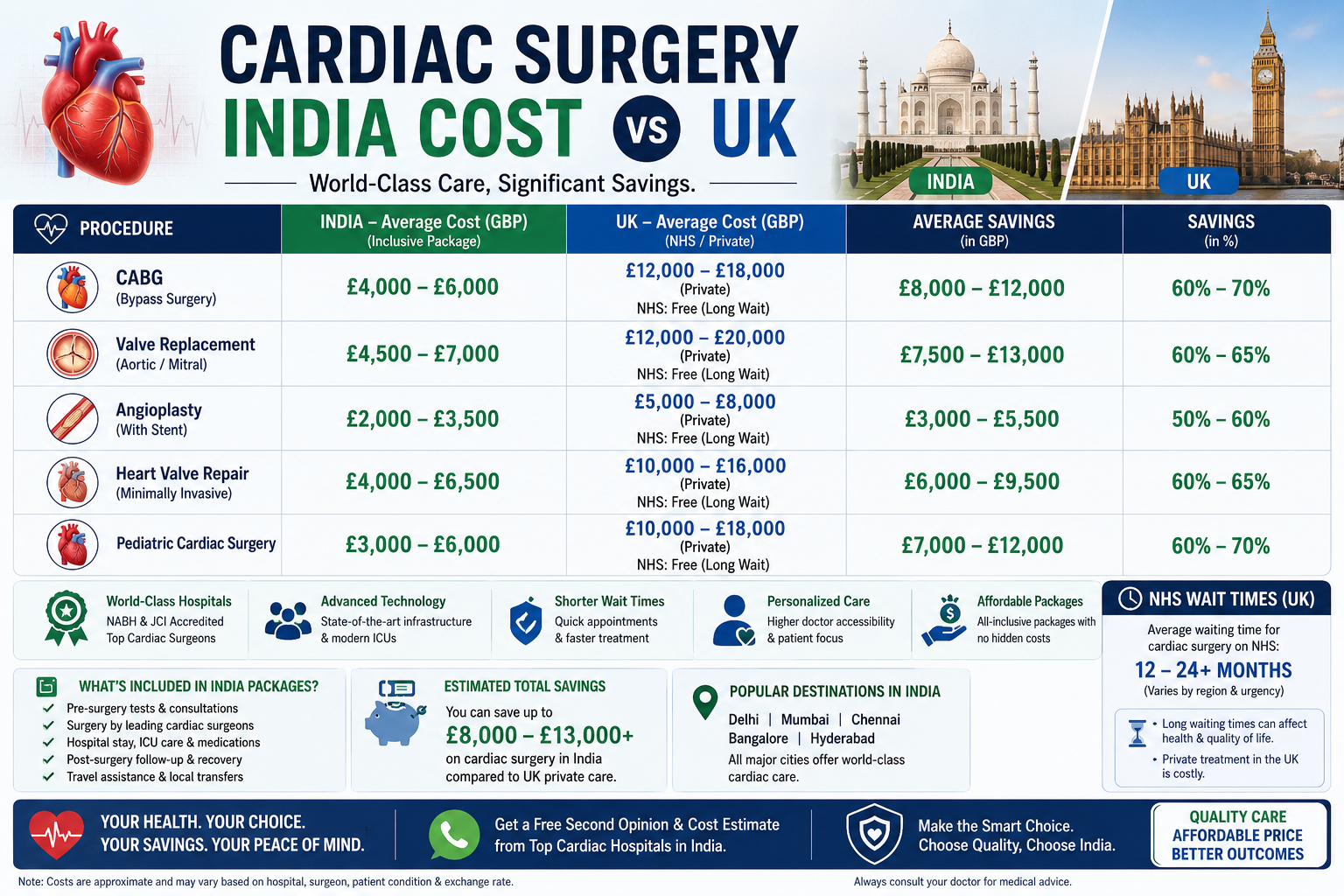
Bypass surgery — clinically known as Coronary Artery Bypass Grafting, or CABG — is one of the most commonly performed cardiac procedures in India, and one of the most significant cost advantages India offers international patients compared to hospitals in the US, UK, Australia, or the Gulf. The difference is not marginal. A procedure that costs $80,000 to $130,000 in the United States routinely costs $6,500 to $10,000 at an accredited Indian cardiac centre.
But ‘bypass surgery cost in India’ is not a single number, and patients who plan around a headline figure often encounter surprises. The cost of your bypass depends on how many vessels need to be bypassed, which surgical technique is used, what hospital you choose, how long you stay, and several other clinical variables that can only be assessed after a specialist reviews your reports.
This guide breaks down bypass surgery costs in India procedure by procedure, explains what drives the final number, and tells you exactly what to ask for before accepting any estimate.
Bypass Surgery Cost in India: Procedure-by-Procedure Breakdown
The table below gives realistic cost ranges for CABG procedures at accredited hospitals in India. These are not minimum quotes — they reflect what patients from abroad can realistically expect to budget at hospitals with JCI or NABH accreditation.
|
Procedure |
India (USD) |
USA (USD) |
UK (USD) |
Saving vs USA |
|
Single Vessel CABG |
$5,000–$7,500 |
$70,000–$120,000 |
$25,000–$45,000 |
~90% |
|
Double Vessel CABG |
$6,000–$8,500 |
$80,000–$125,000 |
$28,000–$48,000 |
~92% |
|
Triple Vessel CABG |
$7,000–$10,000 |
$90,000–$135,000 |
$32,000–$52,000 |
~92% |
|
Quadruple Vessel CABG |
$8,500–$12,000 |
$100,000–$145,000 |
$36,000–$58,000 |
~92% |
|
Off-Pump CABG (Beating Heart) |
$7,500–$11,000 |
$90,000–$140,000 |
$30,000–$55,000 |
~91% |
|
Minimally Invasive CABG (MIDCAB) |
$8,000–$13,000 |
$90,000–$150,000 |
$35,000–$60,000 |
~91% |
|
CABG + Valve Repair / Replacement (Combined) |
$10,000–$17,000 |
$120,000–$180,000 |
$45,000–$75,000 |
~92% |
|
Re-do CABG (Previous Bypass History) |
$9,000–$15,000 |
$100,000–$160,000 |
$40,000–$70,000 |
~91% |
Planning note: These ranges apply to accredited hospitals with strong international patient infrastructure. The final figure for your case depends on the variables covered in Section 3. Treat these as budgeting ranges, not fixed quotes.
Understanding CABG: What the Procedure Actually Involves
Before looking at cost in detail, it helps to understand what bypass surgery entails — because the clinical specifics of your procedure directly determine what you will pay.
What CABG Does
Coronary artery disease causes the arteries supplying blood to the heart muscle to narrow or block, typically from atherosclerotic plaque build-up. When blockages are too extensive for angioplasty and stenting, or when multiple vessels are affected, bypass surgery creates new routes — grafts — that allow blood to flow around the blockages and reach the heart muscle effectively.
The number of bypasses required is determined by how many coronary arteries are significantly blocked. A patient with one major blockage may need a single bypass (single vessel CABG); a patient with blockages in three main vessels needs three separate grafts (triple vessel CABG). This is assessed through coronary angiography before surgery is planned.
Where the Graft Vessels Come From
The graft material is taken from the patient’s own body. The two most common sources are:
- Internal Mammary Artery (IMA) — the artery running along the inside of the chest wall. The left IMA is considered the gold standard graft for bypassing the left anterior descending artery (LAD), the most important coronary vessel. IMA grafts have better long-term patency than vein grafts.
- Saphenous Vein — the long vein running along the inside of the leg. Multiple vein segments can be harvested for multi-vessel bypass, making it the standard for additional grafts beyond what the IMA can supply.
- Radial Artery — from the forearm. Used in some cases as an alternative arterial graft with good long-term outcomes. Less commonly used than IMA or saphenous vein.
The choice of graft material is a surgical decision based on the patient’s anatomy, age, co-morbidities, and the surgeon’s assessment. It does not significantly change the cost of the procedure.
On-Pump vs Off-Pump CABG
Traditional CABG is performed on-pump: the heart is stopped, and a cardiopulmonary bypass machine (the ‘heart-lung machine’) takes over circulation during the procedure. Off-pump CABG — sometimes called beating heart bypass — performs the grafts while the heart continues to beat, avoiding the bypass machine.
Off-pump CABG is technically more demanding and not appropriate for all patients, but can reduce certain complications in selected cases, particularly in older patients or those with compromised kidney function. It costs slightly more in India due to the technical complexity and specialised equipment required. Not every cardiac surgeon performs off-pump CABG; if this technique is relevant to your case, ask specifically about your surgeon’s off-pump volume.
8 Variables That Determine Your Final CABG Cost in India
The gap between the lower and upper end of any cost range is explained by the following variables. Understanding them helps you interpret quotes and ask the right questions.
|
1 |
Number of Vessels Bypassed This is the single largest driver of cost variation within CABG. Each additional bypass vessel adds operative time, complexity, and resource use. A single vessel CABG typically runs $5,000–$7,500; a quadruple vessel CABG at the same hospital with the same surgeon may run $8,500–$12,000. Your angiography report determines the number required. |
|
2 |
Surgical Technique: On-Pump vs Off-Pump Off-pump (beating heart) CABG adds $1,000–$2,500 over standard on-pump CABG at most Indian hospitals, reflecting the greater technical difficulty and specialised equipment. Minimally invasive approaches (MIDCAB) cost more still, but are only appropriate for limited vessel disease. |
|
3 |
Hospital Tier and City Premier cardiac centres in Delhi (AIIMS, Fortis Escorts, Max), Mumbai (Kokilaben, Wockhardt), Chennai (Apollo, Fortis Malar), Hyderabad (CARE, Yashoda), and Bangalore (Narayana, Manipal) vary in pricing. Top-tier JCI and NABH-accredited hospitals in metro cities are at the upper end of the range; leading hospitals in smaller cities — Chandigarh, Kochi, Ahmedabad — often offer equivalent outcomes at 10–20% lower cost. |
|
4 |
Surgeon’s Seniority and Volume Senior cardiac surgeons with 20+ years of experience and high annual CABG volumes charge more than junior surgeons. For straightforward CABG, the fee premium is typically $800–$2,000. For complex cases — re-do surgery, combined procedures, patients with multiple co-morbidities — choosing a high-volume senior surgeon is not an optional premium but a clinical priority. |
|
5 |
ICU Duration and Hospital Stay Standard post-CABG recovery in India runs 2–4 days in the ICU and 5–7 days in a standard ward, totalling 7–10 days. Complications, co-morbidities such as diabetes or kidney disease, or arrhythmia post-surgery can extend the ICU stay significantly. ICU charges at top Indian cardiac hospitals run $200–$400 per day; ward charges $80–$200 per day depending on room category. |
|
6 |
Room Category Indian hospitals offer general ward, twin-sharing, private room, and suite options. The difference between a private room and a suite can be $80–$250 per day. Over a 10-day stay, this adds $800–$2,500 to your bill. Most international patient packages default to a private room; confirm this upfront. |
|
7 |
Pre-Operative Investigations If you arrive without a complete cardiac workup, the hospital will need to perform coronary angiography ($700–$1,200), echocardiogram ($100–$250), CT angiography if required ($500–$900), pulmonary function tests ($80–$150), and a pre-operative blood panel ($150–$300) before CABG can be planned. Patients with recent comprehensive reports from their home cardiologist can substantially reduce this component. |
|
8 |
Co-Morbidity Management Patients with diabetes, hypertension, kidney disease, or chronic lung disease require additional pre-operative optimisation and more intensive post-operative monitoring. A diabetic patient whose blood sugar is poorly controlled pre-operatively may require endocrinology input, extended observation, and a longer ICU stay — each of which adds to the final bill. |
What Is and Is Not Included in a CABG Package
Indian hospitals quote bypass surgery in two ways: a lump-sum package or an itemised estimate. Both can be misleading if you don’t verify what’s actually covered. Here is what to expect and what to check:
|
Generally Included |
Often Not Included — Verify Explicitly |
|
Surgeon’s fee and anaesthesiologist’s fee |
Pre-operative investigations (angiography, echo, blood panel) |
|
Operation theatre charges |
Cardiologist consultation fees (pre and post) |
|
Standard ICU stay (2–4 days) |
Additional ICU days beyond package allocation |
|
Standard ward stay (5–7 days) |
Extended ward stay due to complications or slow recovery |
|
Routine post-operative medications (inpatient) |
Blood and blood products if required during or after surgery |
|
Standard nursing care |
Physiotherapy and cardiac rehabilitation sessions |
|
Routine post-operative investigations (ECG, echo, blood) |
Discharge medications (typically 3–6 months of cardiac drugs) |
|
Meals during hospital stay |
Companion accommodation within the hospital room |
|
Discharge summary and complete medical records |
Airport transfer and local transport |
|
The Implant Question Unlike valve surgery, CABG does not use an implanted device, which simplifies the cost picture considerably. The graft material comes from the patient’s own body. There is no implant cost in standard CABG — but if your procedure includes a combined valve replacement or a ventricular assist device (LVAD), implant cost becomes highly significant. Confirm explicitly whether your procedure is CABG only or combined. |
Total Trip Budget: Beyond the Surgery Bill
Your CABG bill is the largest cost, but planning your trip requires accounting for everything outside the hospital. Here is a realistic breakdown for an international patient travelling to India for bypass surgery with one companion:
|
Cost Component |
Estimated Range (USD) |
Notes |
|
Surgery (double or triple vessel CABG) |
$6,000–$10,000 |
Dependent on vessels, hospital, surgeon seniority |
|
Return flights (patient + companion) |
$600–$2,800 |
Varies by origin. Post-surgery return may require business class or medical clearance for flight |
|
India medical visa (2 persons) |
$50–$200 |
India medical e-Visa is straightforward; valid 1 year, multiple entries |
|
Pre-surgery hotel stay (3–5 days) |
$150–$500 |
Required for pre-op investigations and consultations before admission |
|
Post-discharge stay (10–14 days) |
$500–$1,400 |
Hospitals typically require patients to remain locally available for 10–14 days before flying post-CABG |
|
Companion meals and local expenses |
$300–$800 |
Food costs in India are low; budget more for metro cities |
|
Local transport (airport, hospital, hotel) |
$100–$300 |
Most hospitals provide complimentary airport transfer for international patients |
|
Discharge medications (3 months) |
$80–$220 |
Post-CABG medications in India cost a fraction of Western pharmacy prices |
|
Travel and health insurance |
$150–$500 |
Strongly recommended; verify coverage for planned cardiac procedures abroad |
|
Estimated Total (Double / Triple CABG trip) |
$8,000–$16,000 |
Including all above components. Compare to $80,000–$135,000 for the surgery alone in the US. |
India’s Bypass Surgery Experience: Why Volume Matters
For international patients considering bypass surgery in India, the cost advantage is clear. What is sometimes less well understood is the clinical case for India — particularly the relevance of surgical volume.
India’s leading cardiac centres perform extremely high volumes of CABG. Surgeons at top hospitals in Delhi, Mumbai, Chennai, and Hyderabad perform several hundred to over a thousand bypass procedures annually — volumes that translate directly into precision, lower complication rates, and better outcomes across the evidence base. A Western cardiac surgeon performing 100–150 CABGs per year is considered high-volume by US and UK standards. Indian counterparts at high-volume centres routinely exceed this.
For bypass surgery specifically, this matters because:
- CABG outcomes improve consistently with surgeon and institutional volume across studies
- High-volume centres have more experienced ICU and perfusion teams, not just surgeons
- Re-do surgeries and complex multi-vessel cases benefit most from high institutional experience
- Post-operative arrhythmia management, a common challenge post-CABG, is handled more effectively by experienced cardiac ICU teams
India’s top cardiac centres also offer off-pump CABG, minimally invasive approaches, robotic-assisted bypass, and hybrid revascularisation procedures — technologies that are available in the West but not always accessible outside major academic centres.
Bypass Surgery Cost: India vs Other Countries
|
Country |
Single Vessel (USD) |
Triple Vessel (USD) |
JCI Hospitals Available |
English Widely Spoken |
Wait Time |
|
India |
$5,000–$7,500 |
$7,000–$10,000 |
Yes (30+) |
Yes |
1–3 weeks |
|
Thailand |
$14,000–$20,000 |
$18,000–$26,000 |
Yes |
Partial |
1–2 weeks |
|
Turkey |
$9,000–$14,000 |
$11,000–$16,000 |
Yes |
Limited |
1–3 weeks |
|
Malaysia |
$11,000–$16,000 |
$15,000–$20,000 |
Yes |
Yes |
1–2 weeks |
|
USA |
$70,000–$120,000 |
$90,000–$135,000 |
Yes |
Yes |
Variable |
|
UK (Private) |
$25,000–$45,000 |
$32,000–$55,000 |
Yes |
Yes |
Weeks–months |
|
Australia (Private) |
$30,000–$50,000 |
$40,000–$65,000 |
Limited |
Yes |
Weeks–months |
Getting an Accurate Bypass Surgery Cost Estimate: Step by Step
A general cost range is a starting point, not a plan. Here is how to convert a planning range into a reliable estimate for your specific case:
|
1 |
Start with Your Coronary Angiography Report Bypass surgery planning begins with an angiogram. Your angiogram report tells the surgeon which vessels are blocked, the degree of blockage, and whether CABG is indicated over angioplasty. If you have not yet had an angiogram, this is the first step — it can be done in India as part of your workup if needed. |
|
2 |
Gather Your Complete Cardiac File Collect your most recent echocardiogram (assesses heart function and ejection fraction), ECG, recent blood reports, any previous cardiac procedure reports, and a current list of medications. If you have had previous cardiac surgery, bring those operative notes. This documentation allows a specialist to assess your case properly before giving you a meaningful estimate. |
|
3 |
Request a Written Specialist Opinion Before Asking for Cost Share your reports with the hospital or facilitator and request a written specialist review first. A cost estimate given without a clinical review is a marketing figure, not a medical one. The specialist’s review will confirm whether CABG is indicated, how many vessels, and which technique is appropriate — all of which determine cost. |
|
4 |
Request an Itemised Estimate, Not a Package Total Once you have a clinical recommendation, ask for a line-by-line breakdown: surgeon fee, anaesthesia, OT charges, ICU days and daily rate, ward days and daily rate, standard investigations, medications. Ask separately what the cost is for additional ICU days beyond the estimate. This is the only basis for an honest comparison. |
|
5 |
Ask About Your Specific Surgeon Confirm the name, qualifications, and annual CABG volume of the surgeon who will perform your procedure. A hospital quote is not the same as a quote from the specific surgeon. For complex cases or re-do surgery, confirm that the senior surgeon quoted is the one who will operate, not a junior under supervision. |
|
6 |
Arrange a Video Consultation Before Committing to Travel Before booking flights, arrange a video consultation with the operating surgeon. This serves two purposes: you get a direct clinical assessment, and the surgeon can refine the estimate based on their own review of your imaging. It also gives you the opportunity to evaluate the surgeon directly before making any commitment. |
Special Situations That Affect Bypass Surgery Cost
Re-Do Bypass Surgery
If you have had a previous CABG and require repeat bypass surgery, costs are higher than a primary procedure for several reasons: the operative field contains adhesions and scar tissue from the previous surgery, the procedure takes longer, risk of bleeding is elevated, and the surgical team requires greater experience to navigate safely. Re-do CABG in India typically costs $9,000–$15,000 at a top centre — significantly more than a first-time procedure, but still far below Western equivalents. For re-do surgery specifically, hospital and surgeon selection should prioritise volume and experience above all other factors.
CABG Combined with Valve Repair or Replacement
Some patients require simultaneous valve surgery and bypass — typically when mitral or aortic valve disease is identified alongside coronary artery disease. Combined procedures are longer, more complex, and if valve replacement is involved, carry the additional cost of the implant ($400–$9,000 depending on valve type and manufacturer). Combined CABG and valve surgery in India ranges from $10,000 to $17,000 depending on the valve chosen and hospital tier.
Patients with Diabetes or Kidney Disease
Diabetic patients undergoing CABG require careful blood sugar management pre-operatively and post-operatively, endocrinology input, and are at higher risk of wound healing issues and infection. Patients with chronic kidney disease may require modified anaesthesia protocols and more careful fluid management. Both groups typically have longer ICU stays and higher overall costs. If this applies to you, ask specifically how co-morbidity management affects the cost estimate.
Patients Over 70 or with Low Ejection Fraction
Elderly patients and those with reduced heart function (ejection fraction below 35%) carry higher surgical risk and typically require more intensive post-operative monitoring. This does not necessarily mean bypass surgery is not appropriate — India’s leading cardiac surgeons regularly operate on high-risk patients with excellent outcomes — but it does mean the cost estimate should reflect extended ICU care and a longer overall stay.
What to Be Cautious About When Comparing Bypass Surgery Quotes
- Quotes significantly below $5,000 for CABG should be verified carefully — they may exclude investigations, the anaesthesiologist’s fee, ICU days beyond the first two, or be from non-accredited hospitals
- Package prices that do not specify room category, number of ICU days included, or what happens if the stay extends are not reliable planning figures
- Quotes from coordinators or facilitators without a clinical review of your reports are based on assumptions, not your actual case
- Hospitals that cannot name the specific surgeon who will operate, or that cannot provide the surgeon’s qualifications and volume, should be questioned further
- Very low quotes are sometimes based on shared ward accommodation and junior surgeon teams — acceptable for some patients, but not disclosed upfront
- Re-do CABG quoted at primary CABG prices should be a red flag — re-operative surgery genuinely costs more and requires a different level of expertise
|
Get Your Bypass Surgery Cost Estimate for India The cost of your bypass surgery depends on your specific angiogram findings, the number of vessels, the technique required, and the hospital and surgeon you choose. A general range is the starting point — a case-specific estimate based on your actual reports is what you need to plan. Share your angiogram and cardiac reports with our team. A matched cardiac surgeon will review your case and provide a written clinical opinion and itemised cost estimate — at no charge, with no obligation to proceed. Free. Confidential. Reports reviewed within 24–48 hours. | www.racurehealthcare.com |
🫀 Need Expert Cardiac Care?
Our experienced cardiac surgeons can help you understand your options and plan the best treatment.