📑 Table of Contents
- Aortic Valve Replacement Cost in India
- First: SAVR vs. TAVR — Why the Cost Varies So Much
- SAVR (Surgical Aortic Valve Replacement) — Cost Breakdown
- TAVR / TAVI (Transcatheter Aortic Valve Replacement) — Cost Breakdown
- What Determines Your Exact Cost
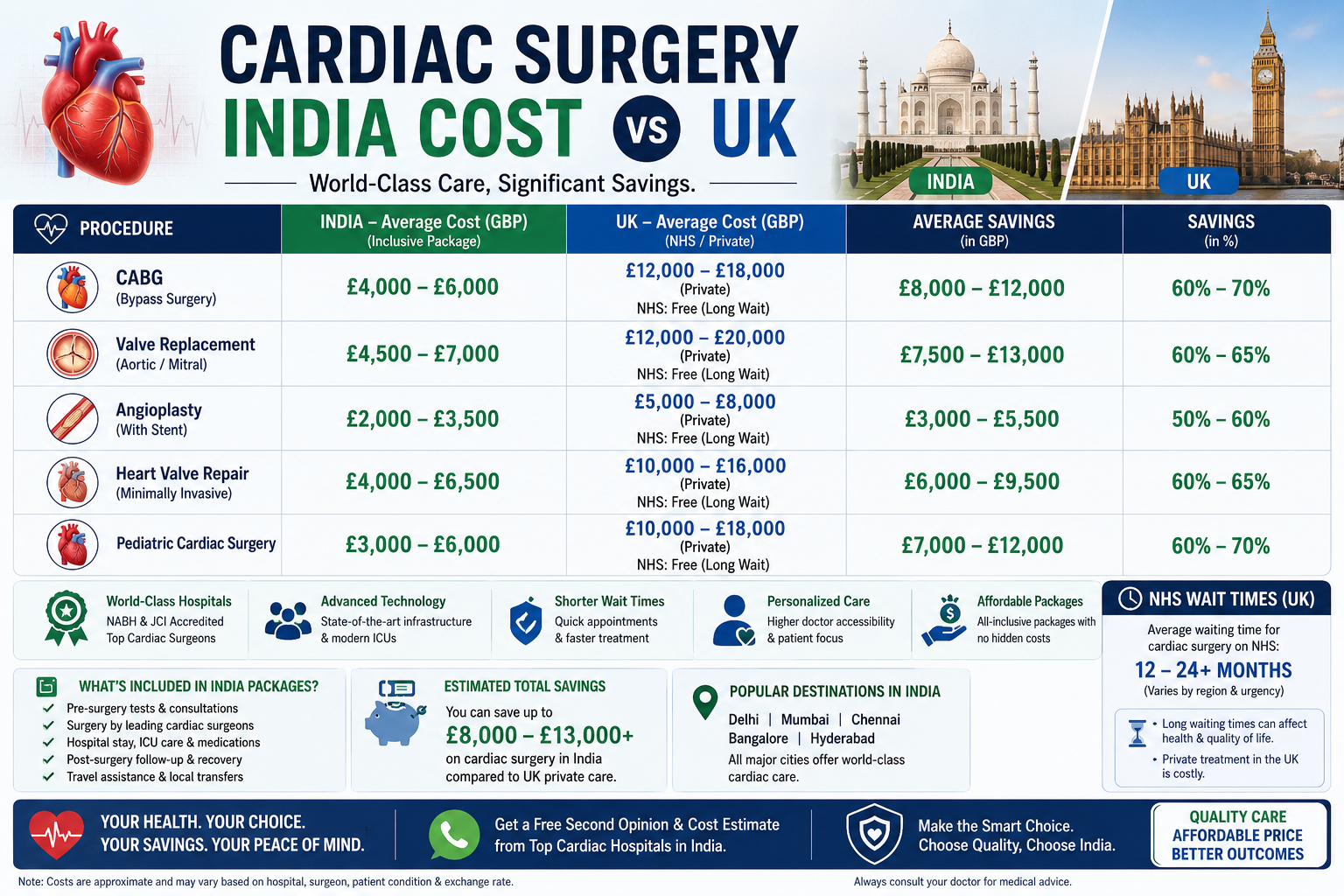
- How India's Pricing Compares Internationally
- What's Typically Included in the Cost Estimate
- SAVR or TAVR — Which One Do You Actually Need?
- How to Get an Accurate Cost Estimate for Your Case
- Frequently Asked Questions
- Get Your Personalized Cost Estimate
Aortic Valve Replacement Cost in India
If you or a family member has been told you need an aortic valve replaced, the cost question that follows is a reasonable and important one. The honest answer is: it depends heavily on which type of procedure you need — and the cost difference between the two main approaches is large enough that this distinction matters more than almost any other single factor.
This article breaks down the real cost of aortic valve replacement in India, explains the difference between traditional open-heart surgery (SAVR) and the minimally invasive transcatheter approach (TAVR/TAVI), and outlines exactly what drives the price up or down in each case.
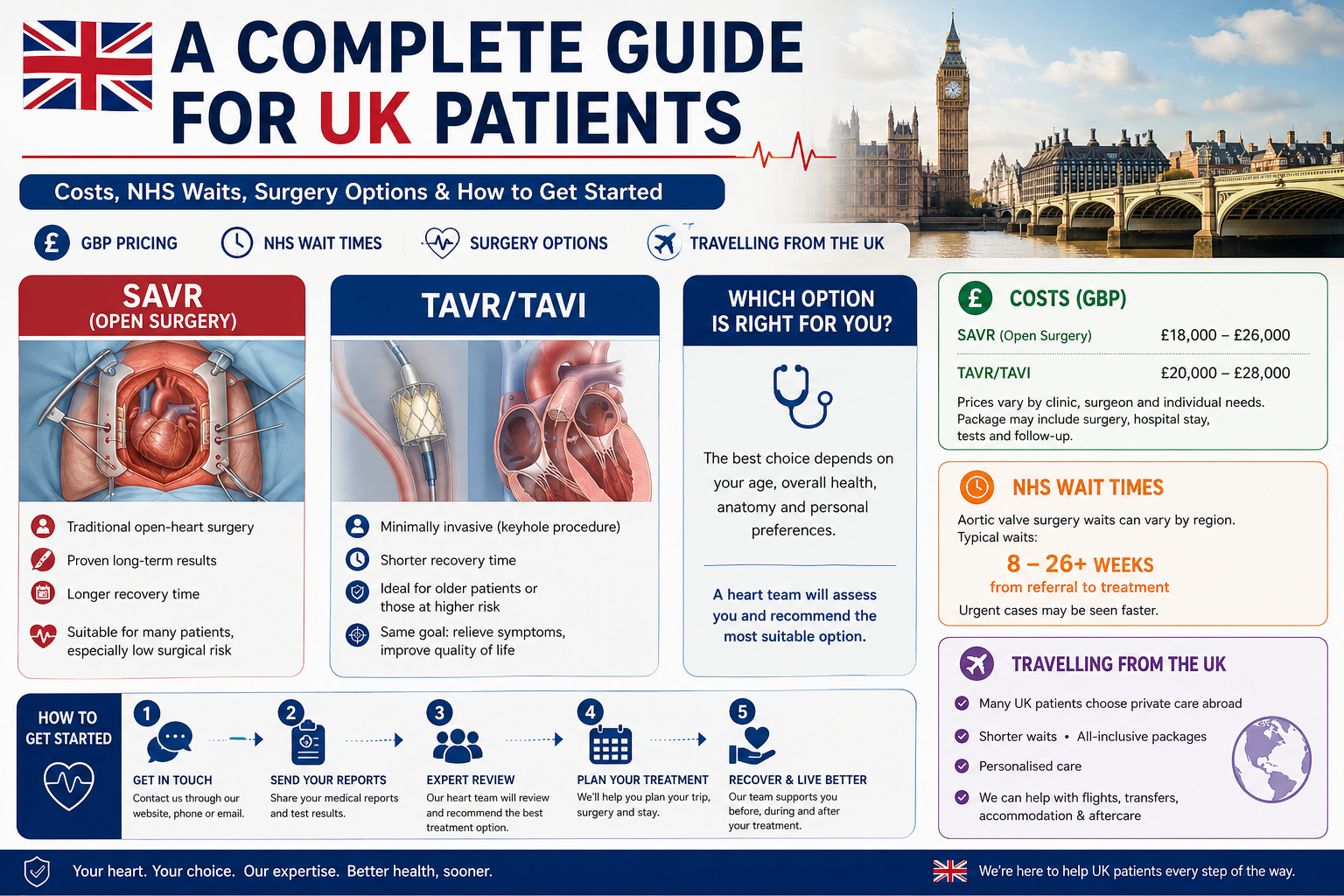
First: SAVR vs. TAVR — Why the Cost Varies So Much
Aortic valve replacement in India is performed using one of two fundamentally different approaches, and they are priced very differently:
|
Aspect |
SAVR (Open-Heart Surgery) |
TAVR / TAVI (Transcatheter) |
|
Approach |
Traditional open-heart surgery via chest incision |
Minimally invasive, valve delivered via catheter (usually through the leg) |
|
Typical Cost Range (USD) |
$5,000 – $9,000 |
$20,000 – $45,000 |
|
Procedure Duration |
4–6 hours |
1–2 hours |
|
Hospital Stay |
7–10 days |
2–4 days |
|
Best Suited For |
Younger, lower-risk patients who can tolerate open surgery |
Older or higher-risk patients, or those with prior cardiac surgery |
|
Recovery Time |
6–12 weeks for full recovery |
2–4 weeks for full recovery |
|
Why TAVR Costs So Much More The higher cost of TAVR/TAVI is driven almost entirely by the valve device itself — the imported transcatheter valve technology (commonly from manufacturers like Edwards Lifesciences or Medtronic) is a highly engineered, expensive component. SAVR's lower cost reflects the use of more conventional valve types and standard open-surgical technique, not a lower standard of care. |
SAVR (Surgical Aortic Valve Replacement) — Cost Breakdown
Traditional open-heart aortic valve replacement remains the standard approach for many patients, particularly younger patients who can tolerate open surgery well. In India, SAVR typically costs between $5,000 and $9,000 (approximately ₹4.2–7.5 lakh) at accredited hospitals, inclusive of surgeon's fees, hospital stay, and standard valve cost.
This is significantly more affordable than TAVR because it doesn't require the imported transcatheter delivery device — the cost is concentrated in surgical time, ICU care, and the valve prosthesis itself, which costs considerably less than transcatheter valve technology.
TAVR / TAVI (Transcatheter Aortic Valve Replacement) — Cost Breakdown
TAVR — also called TAVI (Transcatheter Aortic Valve Implantation) — is a minimally invasive alternative recommended for patients at high or moderate surgical risk, often older patients or those with prior cardiac procedures. In India, TAVR typically costs between $20,000 and $45,000 (approximately ₹15–35 lakh), depending heavily on the valve technology used.
|
Valve Type |
Mechanism |
Approx. Cost (INR, Private Hospital) |
|
Balloon-Expandable Valve |
Mounted on a balloon catheter; deployed via balloon inflation |
₹25–35 lakh |
|
Self-Expanding Valve |
Made from nitinol; self-expands at body temperature |
₹25–35 lakh |
|
Valve-in-Valve TAVR |
For patients with a previously failed surgical bioprosthetic valve |
₹22–35 lakh |
|
Indigenous/Local Valve Options |
Domestically manufactured alternatives, where suitable |
Lower cost than imported valves, varies by hospital |
The valve device itself often represents the single largest component of TAVR cost — frequently more than the hospital stay, surgical team fees, and imaging combined.
What Determines Your Exact Cost
Two patients having what looks like the same procedure can receive very different cost estimates. Here's what actually drives the variation:
- Type of procedure — SAVR vs. TAVR is the single biggest cost driver, often a 3–5x difference
- Valve type and manufacturer — imported devices from international brands cost more than indigenous alternatives
- Hospital and city — metropolitan super-specialty hospitals generally price higher than smaller regional centers
- Pre-procedure imaging and evaluation — TAVR in particular requires detailed CT and echocardiographic assessment that adds to the cost
- Length of hospital stay — complications or a more cautious recovery plan can extend stay and cost
- Surgeon and cardiac team experience — highly experienced structural heart specialists may have higher professional fees
- Room category — private vs. semi-private vs. general ward affects the accommodation portion of your bill
How India's Pricing Compares Internationally
|
Procedure |
Typical Cost in USA |
Typical Cost in India |
|
SAVR (Open-Heart) |
$70,000 – $120,000 |
$5,000 – $9,000 |
|
TAVR / TAVI |
$50,000 – $90,000 |
$20,000 – $45,000 |
Even at the higher end of TAVR pricing, India's cost is roughly half of the US equivalent — and for SAVR specifically, the savings are even more dramatic, often exceeding 90%.
What's Typically Included in the Cost Estimate
- Pre-procedure cardiac evaluation, including ECG, echocardiogram, and (for TAVR) detailed CT imaging
- Surgeon's or interventional cardiologist's fee
- Operating theatre or cath lab charges
- The valve device itself (a major cost component, especially for TAVR)
- Standard hospital stay for the procedure type
- ICU monitoring during the immediate post-procedure period
- Routine post-procedure medication during hospital stay
Typically billed separately or dependent on individual case complexity:
- Extended hospital stay due to complications
- Additional cardiac tests if your condition requires further evaluation
- Premium room category upgrades
- Long-term medication after discharge (e.g., anticoagulants for mechanical valves)
SAVR or TAVR — Which One Do You Actually Need?
This is a clinical decision made by a cardiac team, not a cost-based choice. Generally:
- Younger, lower-risk patients are typically better candidates for SAVR, which has decades of long-term outcome data
- Older patients or those with significant comorbidities are often better suited to TAVR, which avoids the trauma of open-heart surgery
- Patients with a previously failed surgical valve may be candidates for valve-in-valve TAVR rather than repeat open surgery
- The final decision depends on a detailed evaluation by a heart team, including imaging of your specific valve anatomy
|
Get a Clinical Opinion First, Then a Cost Estimate Before focusing on cost, the most important step is getting your case reviewed by a cardiac specialist who can confirm whether SAVR or TAVR is appropriate for your specific condition. The cost estimate should follow that clinical recommendation — not the other way around. |
How to Get an Accurate Cost Estimate for Your Case
. Share Your Cardiac Reports
Send your echocardiogram report, any CT or angiography results, and details of your current symptoms and medical history.
2. Get a Specialist Review
A cardiac specialist will review your case to determine whether SAVR or TAVR is the appropriate approach, and which valve type fits your anatomy and needs.
3. Receive a Written, Itemized Cost Estimate
Once your treatment approach is confirmed, you'll receive a clear cost breakdown — not a vague verbal range — covering the procedure, valve, hospital stay, and any additional testing required.
4. Ask About Total Cost, Including Stay and Travel
If you're traveling from abroad, factor in accommodation for any accompanying attendant and your own recovery period before you're cleared to fly home.
Frequently Asked Questions
Is TAVR always more expensive than SAVR?
In India, yes — TAVR is consistently more expensive than SAVR due to the cost of the transcatheter valve device itself, even though the procedure itself involves a shorter hospital stay and faster recovery.
Does insurance cover aortic valve replacement in India?
Many Indian health insurance policies cover both SAVR and TAVR, though coverage extent varies by insurer and policy, and TAVR coverage in particular is sometimes partial (commonly covering 50–75% of cost). For international patients, check with your home insurer whether overseas treatment is covered at all, since this varies significantly.
How long is the hospital stay for each procedure?
SAVR typically requires a 7–10 day hospital stay due to the nature of open-heart surgery. TAVR is far shorter, typically 2–4 days, since it's minimally invasive and doesn't involve opening the chest.
What is the success rate for aortic valve replacement in India?
Success rates for aortic valve replacement in India are generally reported in the range of 90–95%, comparable to international standards, though outcomes depend significantly on patient age, overall health, and the experience of the surgical or interventional team.
Can international patients get TAVR in India?
Yes. India performs both SAVR and TAVR for international patients at several JCI and NABH-accredited cardiac centers, particularly in Delhi NCR, Mumbai, and Chennai, which have well-established structural heart programs.
Get Your Personalized Cost Estimate
Every aortic valve case is different, and the right approach — and the right cost — depends entirely on your specific cardiac evaluation. Share your echocardiogram and medical history with our team, and we'll connect you with a cardiac specialist for a clinical opinion and a written, itemized cost estimate based on your actual case.
|
Get Your Free Cardiac Consultation and Cost Estimate Reports reviewed within 24–48 hours by our medical team. No obligation. |
🫀 Need Expert Cardiac Care?
Our experienced cardiac surgeons can help you understand your options and plan the best treatment.