📑 Table of Contents
- Best Chemotherapy Cost in India
- Why Is Chemotherapy So Much Cheaper in India?
- What Makes Up Your Chemotherapy Bill — Component by Component
- Chemotherapy Cost Per Cycle — By Regimen
- Targeted Therapy and Immunotherapy Cost Per Cycle
- Oral Targeted Therapy — Monthly Cost Comparison
- Full Chemotherapy Course Cost — By Cancer Type
- Costs That Are Frequently Overlooked — Budget for These
- Chemotherapy Cost Variation Across Indian Cities
- How to Get an Accurate Chemotherapy Cost Estimate
- Frequently Asked Questions
- Get Your Personalised Chemotherapy Cost Estimate
Best Chemotherapy Cost in India
Chemotherapy is the treatment most international patients ask about first — and getting an accurate cost figure is harder than it should be. Most hospitals will quote you a per-cycle drug cost. What they don't always tell you upfront is that the drug itself is only one component of what you'll actually pay per session and that the number of cycles, the supportive medications, and the monitoring tests across a full course can add substantially to the total.
This article gives you a complete, transparent breakdown of what chemotherapy actually costs in India — per cycle, per protocol, and across a full treatment course — for the cancer types most commonly treated by international patients. It also explains exactly what a cost estimate should include and where to watch for undisclosed costs.
Why Is Chemotherapy So Much Cheaper in India?
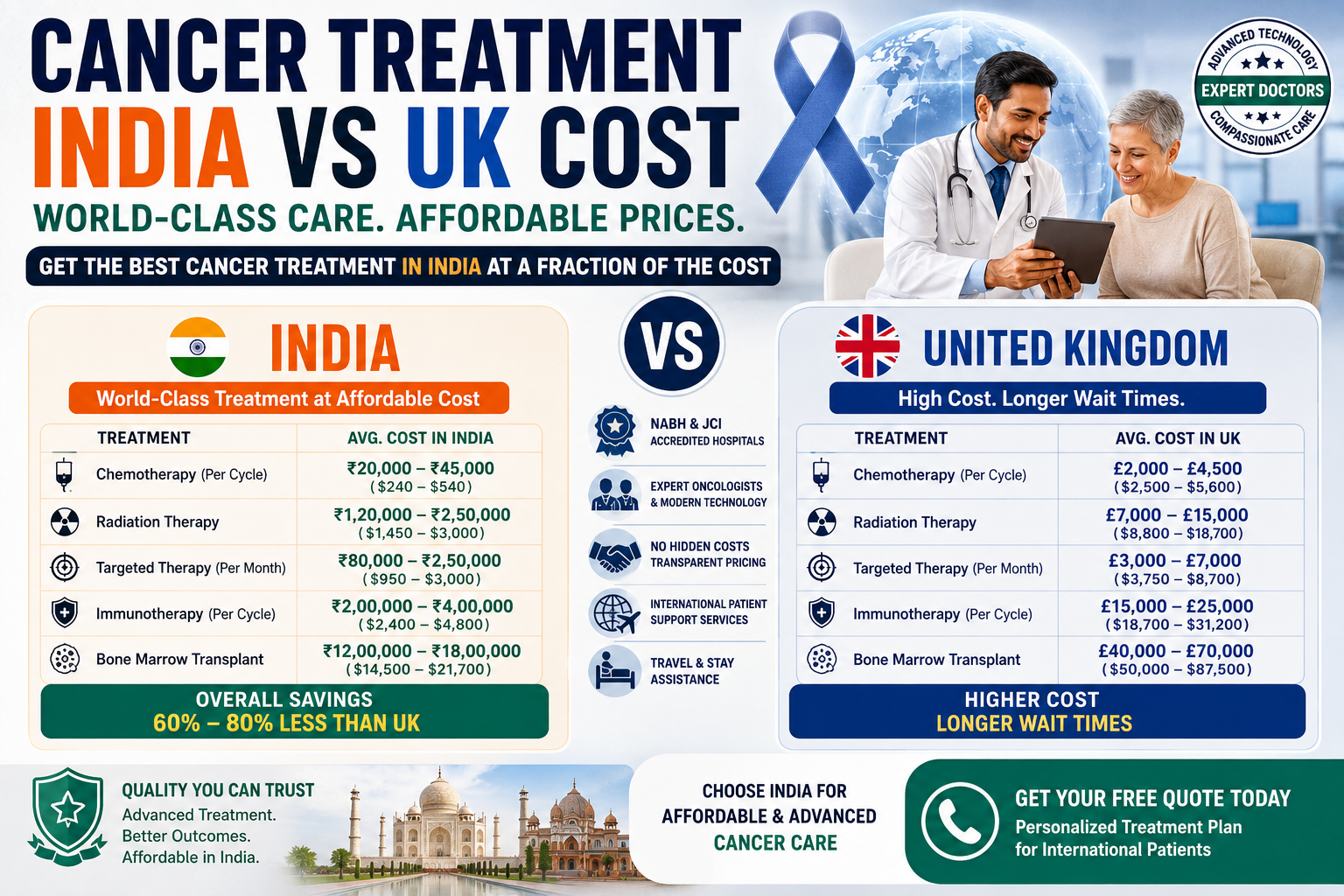
A patient who would spend $30,000 or more on six chemotherapy cycles in the United States can typically complete the same protocol in India for under $7,500 — including hospital administration charges. The reasons are concrete, not vague:
- India manufactures a large proportion of the world's generic oncology drugs — older but highly effective chemotherapy agents like paclitaxel, carboplatin, 5-fluorouracil, and cyclophosphamide are produced domestically at a fraction of Western import costs
- Infusion administration charges — nursing time, chair, IV fluids, monitoring — are significantly lower due to India's different salary and overhead structure
- Day-care chemotherapy delivery is standard practice at India's oncology centres, meaning most patients receive chemotherapy, wait for the session to complete, and go home the same day — eliminating inpatient room charges for routine cycles
- High treatment volume means efficient scheduling and reduced per-patient overhead
|
Generic Drugs, Same Molecules The chemotherapy drugs used in India are the same active molecules used in Western hospitals. Paclitaxel is paclitaxel. Carboplatin is carboplatin. Generic manufacturing produces the same drug at lower cost — this is not a quality compromise. India's pharmaceutical manufacturing is regulated under WHO-GMP standards and supplies drugs to healthcare systems in Europe, Australia, and North America. |
What Makes Up Your Chemotherapy Bill — Component by Component
Before looking at specific costs, understanding what makes up each session's total helps you evaluate estimates accurately and avoid surprises:
|
Cost Component |
What It Covers |
|
Drug cost |
The active chemotherapy agent(s) — usually the largest single component per cycle; varies enormously by drug type |
|
Infusion administration charge |
Day-care suite time, IV access, pump/infusion equipment, nursing supervision — typically $50–$200 per session |
|
IV fluids and pre-medications |
Saline flush, anti-nausea prophylaxis (ondansetron, dexamethasone), antihistamines — often $30–$100 per session |
|
Pre-cycle blood test |
Full blood count, liver function, renal function — required before every cycle to confirm fitness to proceed — typically $30–$80 |
|
Supportive medications |
G-CSF growth factor injections (to prevent neutropenia), blood transfusions, platelet transfusions if needed — highly variable, often not included in base quote |
|
Oncologist review fee |
Consultation with your medical oncologist at each visit — some hospitals include this, others bill separately |
|
Hospital admission (if needed) |
If a cycle causes complications (febrile neutropenia, infection) requiring inpatient care — not in a base quote, but important to budget for |
Chemotherapy Cost Per Cycle — By Regimen
Per-cycle costs vary significantly by regimen. The following ranges are for the all-in cycle cost at accredited private hospitals — drug, administration, IV pre-medications, and standard pre-cycle blood tests — but excluding supportive medication costs which vary by individual patient response:
|
Regimen / Protocol |
Cancer Type |
Cost Per Cycle (USD) |
Typical No. of Cycles |
|
AC (Doxorubicin + Cyclophosphamide) |
Breast |
$350 – $750 |
4 cycles |
|
AC-T (with paclitaxel) |
Breast |
$400 – $900 |
4+4 cycles (8 total) |
|
TC (Docetaxel + Cyclophosphamide) |
Breast |
$500 – $950 |
4–6 cycles |
|
CMF (Cyclophosphamide + Methotrexate + 5-FU) |
Breast |
$200 – $500 |
6 cycles |
|
FOLFOX (Oxaliplatin + 5-FU + Leucovorin) |
Colorectal |
$500 – $1,000 |
6–12 cycles |
|
FOLFIRI (Irinotecan + 5-FU + Leucovorin) |
Colorectal |
$450 – $900 |
6–12 cycles |
|
FOLFOX + Bevacizumab |
Colorectal (advanced) |
$900 – $1,800 |
6–12 cycles |
|
Carboplatin + Paclitaxel |
Lung, Ovarian, Gynaecological |
$500 – $950 |
4–6 cycles |
|
Cisplatin + Gemcitabine |
Lung, Bladder, Cervical |
$450 – $900 |
4–6 cycles |
|
R-CHOP (Rituximab + CHOP) |
B-cell Lymphoma |
$700 – $1,500 |
6 cycles |
|
CHOP (without Rituximab) |
Lymphoma |
$400 – $800 |
6 cycles |
|
BEP (Bleomycin + Etoposide + Cisplatin) |
Testicular, Germ Cell |
$600 – $1,200 |
3–4 cycles |
|
VCD / VRD (Bortezomib-based) |
Myeloma |
$800 – $2,000 |
4–8 cycles |
|
Platinum + Etoposide |
Small Cell Lung Cancer |
$500 – $1,000 |
4–6 cycles |
Targeted Therapy and Immunotherapy Cost Per Cycle
Newer targeted agents and immune checkpoint inhibitors are significantly more expensive per cycle than standard cytotoxic chemotherapy — but still dramatically cheaper in India than in Western countries:
|
Drug |
Cancer Type |
India Cost/Cycle (USD) |
USA Cost/Cycle (USD) |
|
Trastuzumab (Herceptin) |
Breast (HER2+) |
$300 – $800 |
$3,500 – $6,000 |
|
Pertuzumab (Perjeta) |
Breast (HER2+) |
$800 – $1,800 |
$5,000 – $8,000 |
|
Bevacizumab (Avastin) |
Colorectal, Lung, Ovarian |
$300 – $700 |
$2,500 – $5,000 |
|
Cetuximab (Erbitux) |
Colorectal, Head & Neck |
$600 – $1,400 |
$4,000 – $7,000 |
|
Rituximab (MabThera) |
Lymphoma, CLL |
$400 – $900 |
$3,000 – $5,500 |
|
Pembrolizumab (Keytruda) |
Multiple types |
$1,500 – $3,500 |
$12,000 – $22,000 |
|
Nivolumab (Opdivo) |
Lung, Melanoma, Renal |
$1,200 – $3,000 |
$10,000 – $18,000 |
|
Atezolizumab (Tecentriq) |
Lung, Bladder |
$1,000 – $2,500 |
$9,000 – $15,000 |
Oral Targeted Therapy — Monthly Cost Comparison
Oral targeted therapy is taken daily at home rather than through an infusion. For patients on long-term oral protocols — which can run for months or years — the monthly cost comparison between India and Western countries is where India's advantage is most striking:
|
Drug (Brand) |
Cancer Type |
India Cost/Month (USD) |
USA Cost/Month (USD) |
|
Imatinib (Gleevec) |
CML, GIST |
$100 – $300 |
$8,000 – $12,000 |
|
Osimertinib (Tagrisso) |
NSCLC (EGFR+) |
$500 – $1,500 |
$15,000 – $20,000 |
|
Alectinib (Alecensa) |
NSCLC (ALK+) |
$600 – $1,500 |
$15,000 – $20,000 |
|
Palbociclib (Ibrance) |
Breast (HR+/HER2-) |
$400 – $1,200 |
$12,000 – $16,000 |
|
Ribociclib (Kisqali) |
Breast (HR+/HER2-) |
$400 – $1,200 |
$12,000 – $16,000 |
|
Abiraterone (Zytiga) |
Prostate |
$200 – $600 |
$8,000 – $12,000 |
|
Enzalutamide (Xtandi) |
Prostate |
$300 – $800 |
$10,000 – $15,000 |
|
Lenalidomide (Revlimid) |
Myeloma, Lymphoma |
$800 – $2,000 |
$20,000 – $30,000 |
|
Long-Term Oral Therapy: The Case for India For a patient on osimertinib (Tagrisso) for EGFR-positive lung cancer at USD $15,000–$20,000 per month in the US, the same drug costs $500–$1,500 in India. Over a 12-month course, that is a saving of $150,000 or more. Many patients travel to India specifically to obtain their oral targeted therapy dispensed, then continue taking it at home. This is legal and straightforward — you receive your prescription and a supply of medication from your treating oncologist in India. |
Full Chemotherapy Course Cost — By Cancer Type
The most useful planning figure is the full course cost — not per cycle. Here are realistic full-course estimates at accredited private hospitals for the most common cancer types treated by international patients. These figures include drugs, administration, and standard supportive medications per cycle, but exclude imaging, pathology, and hospitalisation for complications:
|
Cancer Type / Protocol |
Total Cycles / Duration |
Full Course Cost (USD) |
|
Breast (early, AC-T) |
8 cycles over ~5 months |
$4,500 – $9,000 |
|
Breast (HER2+, AC-T + Herceptin) |
8 chemo + 18 Herceptin cycles (~1 year) |
$12,000 – $25,000 |
|
Colorectal (FOLFOX, adjuvant) |
12 cycles over ~6 months |
$7,000 – $15,000 |
|
Colorectal (metastatic, FOLFOX + bevacizumab) |
Ongoing; 12 cycles baseline |
$12,000 – $25,000 |
|
Lung (carboplatin + paclitaxel) |
4–6 cycles over 3–5 months |
$3,000 – $7,500 |
|
Lung (pembrolizumab monotherapy) |
Every 3 weeks; 35 cycles (2 years) |
$85,000 – $200,000 |
|
Lymphoma (DLBCL, R-CHOP) |
6 cycles over ~5 months |
$6,000 – $12,000 |
|
Ovarian (carboplatin + paclitaxel) |
6 cycles over ~5 months |
$4,000 – $8,000 |
|
Cervical (concurrent cisplatin + radiation) |
5–6 weekly cycles alongside radiation |
$2,000 – $4,500 |
|
Myeloma (VRD induction) |
4–8 cycles over 4–8 months |
$8,000 – $20,000 |
Costs That Are Frequently Overlooked — Budget for These
The gap between what an initial quote says and what patients actually spend is almost always explained by these categories. Ask about each one explicitly before agreeing to a hospital or protocol:
Supportive Medications Per Cycle
G-CSF injections (filgrastim, pegfilgrastim) to prevent neutropenic complications are not included in most base quotes. These can cost $100 to $400 per injection, and many protocols require them after every cycle. Ask your oncologist upfront whether your protocol typically requires G-CSF support and what it costs.
Blood Products
If chemotherapy causes significant anaemia or thrombocytopenia (low platelets), blood or platelet transfusions may be required. A single unit of packed red cells typically costs $50 to $150. Patients on aggressive protocols may need multiple transfusions across the course.
Pre-Cycle Imaging
CT or PET-CT scans every 2 to 3 cycles are standard practice for most cancers to assess treatment response. These are not included in chemotherapy quotes. Budget $150 to $400 per scan, typically 2 to 3 times during a standard course.
Complications Requiring Admission
Febrile neutropenia — fever during the period of lowest white blood cell count after chemotherapy — is a medical emergency requiring immediate inpatient treatment with IV antibiotics. This is not a routine cost, but it occurs in 10 to 15 percent of patients on standard protocols. A 3 to 5 day admission typically costs $500 to $2,500.
Drug Cost vs Administration Quote: Read Both
Some hospitals quote only the drug acquisition cost, leaving administration, pre-medications, and supportive care as separate items that appear on your actual bill. Others provide an all-inclusive per-session price. Always clarify which type of quote you are receiving and ask for the full per-session breakdown before your first cycle.
Chemotherapy Cost Variation Across Indian Cities
Costs at accredited private oncology centres vary somewhat by city, reflecting local operating costs and hospital positioning. For standard cytotoxic chemotherapy protocols, the difference is relatively small. For newer targeted agents and immunotherapy, drug costs dominate and city variation is minimal.
|
City |
Standard Chemo (Per Cycle, USD) |
Relative Cost Level |
|
Mumbai (private, e.g. Kokilaben, Apollo) |
$400 – $1,000 |
Slightly higher — major metro, premium facilities |
|
Delhi NCR (e.g. Medanta, Fortis, Max) |
$350 – $950 |
Moderate-high — large concentration of premier centres |
|
Chennai (e.g. Apollo Chennai) |
$300 – $800 |
Moderate — strong oncology, slightly lower overhead |
|
Hyderabad (e.g. Apollo Hyderabad, KIMS) |
$280 – $750 |
Moderate — competitive pricing, strong facilities |
|
Bengaluru (e.g. Manipal, HCG) |
$280 – $750 |
Moderate — good oncology infrastructure |
|
Tata Memorial Mumbai (government) |
$50 – $300 |
Lowest — subsidised; longer waits; queue-based system |
|
AIIMS Delhi (government) |
$50 – $250 |
Lowest — subsidised; highest academic oncology reputation |
|
Government Hospitals: Lowest Cost, Different Experience Tata Memorial Centre and AIIMS Delhi offer genuinely world-class oncology at dramatically lower cost than private hospitals — subsidised by the government. The trade-off is significantly longer wait times, larger patient volumes, less personalised international patient support, and a more institutional experience. For international patients who value speed, dedicated coordination, and English-language service, private accredited hospitals are typically the better fit. |
How to Get an Accurate Chemotherapy Cost Estimate
A meaningful chemotherapy cost estimate requires specific information. Share the following with any hospital you approach:
- Your confirmed cancer type and histology (the specific pathological subtype matters — e.g., HER2-positive invasive ductal carcinoma, not just 'breast cancer')
- Your stage (I–IV, with sub-staging where available)
- Your biopsy or pathology report
- Molecular profiling results if available — HER2 status, EGFR, ALK, BRCA, PD-L1, etc.
- The chemotherapy protocol recommended by your oncologist, if you already have a recommendation
- Whether this is first-line treatment or you have had previous chemotherapy
With this information, a medical oncologist can identify the appropriate protocol, confirm the number of cycles required, and provide an itemized per-cycle estimate and full-course total — not a vague range.
Frequently Asked Questions
Is generic chemotherapy as effective as branded versions?
Yes. Generic chemotherapy drugs contain the same active molecule as the original branded versions and are required to meet the same efficacy and safety standards. Paclitaxel, carboplatin, cisplatin, cyclophosphamide — all are available as generics in India. Newer targeted agents may be available as biosimilars (biologically similar molecules), which also meet regulatory requirements for comparability to the originator product.
Can I receive each chemotherapy cycle in India and return home between cycles?
Yes — this is a common approach for international patients. Most standard protocols space cycles every 2 to 3 weeks. Many patients receive their cycle in India (which involves 1 to 3 days at the hospital depending on infusion duration), return home, have their blood monitoring done locally, and return to India for the next cycle. Your Indian oncologist and home doctor can communicate via your cycle documentation.
Will I need to stay in India for the full duration of chemotherapy?
For multi-month protocols, most international patients choose to return to India for each cycle rather than staying continuously. Extended stays are also possible if preferred — your patient coordinator can arrange accommodation for the full duration. The right approach depends on your protocol length, your logistical situation, and how you respond to treatment.
Do I need a separate oncologist consultation at each cycle?
Yes — before every chemotherapy cycle, your medical oncologist will review your blood test results, assess your current symptoms, and confirm that you are fit to proceed. This consultation is brief but important. Some hospitals include it in the per-cycle charge; others bill it separately. Confirm this when reviewing your cost estimate.
Are there hospitals in India that specialise specifically in my cancer type?
Yes. India has cancer-type specialist centres and multidisciplinary teams covering all major tumour types. For example, Tata Memorial has dedicated disease management groups for breast, gastrointestinal, thoracic, and haematological cancers. HCG Cancer Hospital network specialises exclusively in oncology. Share your specific cancer type with our team and we will match you to the most appropriate specialist and institution for your diagnosis.
Get Your Personalised Chemotherapy Cost Estimate
Every chemotherapy protocol is different, and a meaningful estimate requires your actual diagnosis. Share your pathology report and staging information with our team, and we will provide a written, protocol-specific cost estimate — per cycle and full course — from a matched oncology specialist at an accredited hospital.
|
Get a Free, Protocol-Specific Chemotherapy Cost Estimate Share your pathology report — reviewed within 24–48 hours. No obligation. |
🫀 Need Expert Cardiac Care?
Our experienced cardiac surgeons can help you understand your options and plan the best treatment.